You are here
Solar thermal based Air-Conditioning System proves itself in India
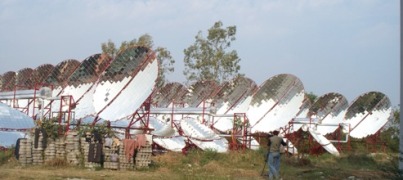
Showcase: These parabolic dishes supply a solar air-conditioning plant of a hospital in Gujarat state in western India and replace 1 ton of wood consumption every day. Photo: Gadhia Solar Energy Systems
India’s latest and probably most largest solar thermal based air-conditioning system went operational at Muni Seva Ashram (MSA) in Goraj, situated in the Vadodara district of Gujarat state in western India. A total of 100 parabolic dishes (Scheffler type) by the Indian company Gadhia Solar Energy Systems (GSES) - each 12.5 m2 in size - now supply the already existing 100-ton air-conditioning system of the 160-bed hospital at Muni Seva Ashram.
“We had to integrate the solar steam system into the already existing vapour absorption chiller circuit, which had so far been run with around 1 ton of wood every day”, Deepak Gadhia, founder and Managing Director of GSES, describes the engineering challenges during this ambitious project. Now, the sun saves this huge amount of wood by delivering 400 kg of steam per hour, at a pressure of 7.5 bar.
The absorption chiller is a two-step machine with a COP (coefficient of performance) of 1.12. First, it generates cold water of 6 ° Celsius and then pumps the water to an air handling unit of the building. Moreover, Gadhia included in its planning a tank that can hold 95,000 litres of cold water, in order to overcome cloudy periods and guarantee a steady output of the air-conditioning unit. It is the first solar air conditioning system GSES has ever designed or installed. The Indian company received a grant from the federal Ministry of New and Renewable Energy (MNRE) for it.
The idea of solar air-conditioning emerged when Vikram Patel, Chairman of Muni Seva Ashram jokingly said that everyone produces heat when it's hot but what was needed was cooling when it's hot! In the past, GSES had already supplied solar steam cooking systems to MSA, which facilitated the decision to work with GSES also on the idea of solar cooling.
The success of the MSA solar cooling system could serve as a fitting example for the country to consider more solar thermal cooling systems.
More reading at: www.gadhia-solar.com/
This news is provided by Jaideep Malaviya, a solar energy expert based in India. malaviya@solrico.com


You made some good points
You made some good points there. I believe most people will concur with your site.
Latest India News
The existing chillers are
The existing chillers are absorption chillers. They require steam, not electricity. As would a steam powered generator. The problem isn't steam, it's that they are burning wood to generate steam. If they had electric chillers, they would still have to burn wood to generate steam to drive the steam turbine to make electricity for the chillers. Instead, they are using the solar concentrators to generate steam for the existing equipment. Absorption chillers are actually highly efficient themselves, so using a sustainable source like solar to provide the heat needed to drive them has a lot of potential. Where electricity is inexpensive and available, electric chillers are hard to beat, but where electricity is expensive or hardly available, this could be an option.
A simpler approach
Why not use a steam powered generator to produce electricity which the air conditioner uses? Safer and simpler.
Gujarat is a north-western
Gujarat is a north-western state in India.
Malaysia, to my knowledge, has no such installation.
To my knowledge, an ADsorption (different from Absorption) chiller operates at some 1KW of energy requirement when driven by thermal sources (wood, solar, waste heat etc) as opposed to conventional 60KW chiller system for a 150RT system.
The key is to harness heat source from waste or renewable solar source. Solar thermal energy can be stored for night use and when rainy/cloudy.
I expect this installation uses absorption system? The environmental footprint is still considerable due to liquid chemical that needs to be topped up regularly. ADsorption chiller technology claims better features and considerably reduced environmental and maintenance impact.
I wish it come Malaysia
I wish it come Malaysia soon..Mr Lim Guan Eng, please help to bring this technology back to Penang ^^
I have never known about
I have never known about this one and I am so amazed. Was this in Malaysia? solar powered air conditioning system maybe I can add this to my science subject report soon.
Regards,
Mike
Absorption Vs ADsorption air conditioning
It is great that India's Muni ahsram is running with an ABSORPTION CHILLER. Thanks to Sri Ghadia, who has taken lots of interests in this development as show case.
However, absorption chiller demands high temperature and steady temperature input also involved with chemicals like lithium bromide and distilled water. operating with 3-4 pumps for liquid circulation. also risks of air entrapping/ stratification etc., Of course close supervision and operation gives lot of advantage over mechanical compressor operated air conditioning.
on the otherhand aDsorption air con operates with minimum electric power/ supervision/ variable temperatures. At present these systems are not popular in the market and cost is very high for the time being.
I wish Mr. Ghadia also take one aDsorption project and differentiate the operation with both the systems.
In Malaysia i am not aware the aDsorption in asia is available in Manila for the time being running in a Japanese operated plant on solar power.
regards
Chary TSR
air conditioning
Never heard of this one, I was so amazed :) was this in malaysia? solar powered air conditioning system maybe I can add this to my science subject report. though picture supplied is not that clear but its good enough.