Outlook 2026–2028: mapping the future of industrial solar heat
May 7, 2026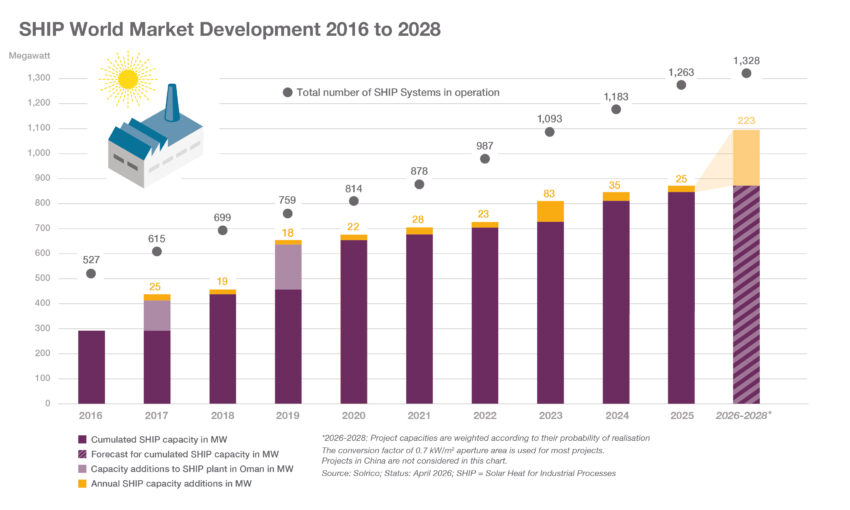
The project pipeline of solar industrial heat developers is robust and expanding. For the Solar Industrial Heat Outlook 2026–2028, developers reported 65 projects with a weighted capacity of 223 MW. “Weighted” means that each project is included in the Outlook according to its likelihood of implementation – counted at 30%, 60%, or 100% of its capacity, depending on its stage of development. If all announced projects were to be realized, the total capacity would reach as much as 352 MW – roughly twelve times the solar heat for industrial processes (SHIP) capacity installed in 2025 (28 MW), and a substantial share of the total global SHIP capacity of 1,099 MW at the end of 2025. Taken together, the Outlook provides a strong indication of steady diversification both geographically and sectorally. The SHIP survey was financed by National Resources Canada, while the creation of the graphics were financed by the German research project ProSolNetz. The charts in this news article are available for download at the bottom of the article. You can also read the news about the results of the SHIP world market survey 2025 here. Source: Solar Industrial Heat Outlook 2026-2028
The Outlook is based on a collaborative effort by the project development sector. In this year’s survey, 30 companies from 17 countries shared data on their project pipelines, almost matching last year’s Outlook 2025–2027, when 29 companies from 15 countries participated. The purpose of the Outlook is to highlight short-term trends and prospects in the global SHIP market.
The announced global SHIP capacities for the period 2026–2028 are slightly lower than those reported in last year’s Outlook 2025–2027. At that time, 73 projects with a total weighted capacity of 277 MW were included. This year, the Outlook covers 65 projects with a combined weighted capacity of 223 MW.
This decrease is partly due to methodological adjustments in how the Outlook is compiled. In general, a larger number of projects have been included this year with only 30% of their capacity counted, even in cases where funding approvals had already been granted. In previous editions, projects with confirmed funding were typically weighted at 60% of their capacity. However, two years of experience with the Outlook have shown that projects may still face delays during implementation or may even be cancelled by the client, despite having secured funding approval.
Another important methodological aspect should be noted: the Outlook includes again projects worldwide but excludes China, as reliable and verifiable project information from there remains difficult to obtain.

Regional distribution of the announced SHIP projects. Capacity was calculated using the factor 0.7 kW/m2 for all collector types. Source: Solar Industrial Heat Outlook 2026-2028
Chile and Southern Europe at the forefront of SHIP development
Chile and Southern Europe dominate the Outlook 2026–2028. This is largely due to the multi-MW flat-plate collector systems currently under construction in Chile’s copper industry. Consultant Ian Nelson confirmed that construction of the two collector fields for the Minera Escondida mine, with capacities of 90 MW and 23 MW, is well advanced. The collector fields are largely installed, and work is now focused on building the connecting pipelines to the technical facilities. The start of construction for the third plant in Spence, with a capacity of 41 MW, has been delayed. For all three projects, the energy provider Gasco has signed heat delivery contracts with the mines. The mines aim to cover 80% of their heat demand with solar thermal energy and the remaining 20% with electric boilers.
A quarter of the newly planned SHIP capacity is expected to be installed in Southern Europe. Project developers reported 24 projects with a total weighted capacity of 56.7 MW. The largest share is in France, with 9 projects (27.7 MW), followed by Spain with 10 projects (19.2 MW), and Greece with one project (7.3 MW).
The most advanced project currently is a large-scale plant for Heineken near Athens, Greece, which is being built and will be operated by the German engineering firm Protarget. The parabolic trough collectors with a peak thermal power of 7.3 MW are currently being pre-assembled in tents and installed on a field at the company’s site. The collector field will provide 280 °C thermal oil to a steam boiler which produces fully saturated steam at 188 °C and 12 bar for the client’s steam network. Commissioning is planned for June 2026.
Construction of another large-scale plant in France is imminent. New Heat is planning and building a 14.4 MW flat-plate collector system for a food producer in the Pays de la Loire region in western France. An EPC contract has been awarded to the Austrian collector manufacturer Greenonetec. The project is being supported through ADEME’s large-scale solar thermal program.
In Spain, a multi-megawatt plant is also currently under construction. The company Solarwall is building a 7 MW air collector system in Andalucia, Spain, for drying agricultural products.
Regional dynamics in the SHIP pipeline
In the regional distribution of announced SHIP capacity for the coming years, several shifts have occurred compared to the previous year.
For the first time, Brazil and Africa are included. In Brazil, the Swiss company TVP Solar is planning several installations using its evacuated flat-plate collectors in the food and beverage industry. In Africa, two projects have been announced: one in Kenya in the oil and gas sector, and another in South Africa in the agricultural industry.
Mexico, by contrast, has dropped out of the Outlook. A large project in the beverage industry has been put on hold by the client, with implementation postponed indefinitely. The numerous smaller SHIP projects that are typically realized each year in Mexico are not included in the Outlook.
North America is gaining importance for SHIP. While three projects with a total capacity of 1.4 MW were implemented in 2025, five projects with a combined weighted capacity of 7.6 MW have now been announced. These include initiatives by Next Source from the Netherlands, as well as the three Canadian companies Solarsteam, Phoenix Solar Thermal, and Rackam.
The really large projects announced by the U.S.-based company Glasspoint are not included in the Outlook, as their implementation is expected beyond 2028. In a press release in January 2026, the company announced the successful completion of a USD 20 million funding round, enabling the development of its megaprojects in Saudi Arabia and California.
In Saudi Arabia, a 1.5 GW parabolic trough project is planned in cooperation with the aluminum producer Ma’aden. In California, a 750 MW installation has been announced with the mining company Searles Valley Minerals. For both projects, heat supply agreements are expected to be concluded with the respective customers.
As a first phase of the Ma’aden project, a 9 MW pilot plant is planned, which – according to current expectations – is scheduled to be commissioned by 2028 and is therefore fully included in the Outlook.
Due to the dominance of large flat-plate collector projects in Chile, stationary collectors account for approximately 75% of total capacity in the 2026–2028 period.
However, in terms of the number of projects, concentrating collector technologies represent a larger share. A total of 27 projects – equivalent to 42% – have been announced using concentrating technologies, including parabolic trough collectors fields (23 projects), linear Fresnel systems (2 projects), and concentrating dish systems (2 projects).

From agriculture to mining: evolving SHIP applications

Another key aspect highlighted by the Outlook is the industrial sector in which SHIP installations are planned. The following graphic presents the 65 announced projects by industry sector, distinguishing between clients located within and outside Europe. It shows that SHIP continues to be deployed across a wide range of industrial sectors.
As in the past years, the food and beverage industry dominates the Outlook, with a total of 25 projects, including those in the dairy sector. Agricultural applications were also strongly represented in the previous Outlook 2025–2027 and continue to play an important role. A notable development, however, is the growing relevance of mining applications. In this year’s Outlook, nine projects are planned in the mining sector, compared to only five in the previous edition.
Overall, the Outlook 2026–2028 points to a market that is continuing to diversify both geographically and sectorally. While large-scale flagship projects particularly in Chile shape total capacity, a growing number of smaller and mid-sized projects across different regions and industries highlights the increasing maturity of the SHIP market. At the same time, adjustments in methodology and ongoing project uncertainties underline that the market remains dynamic and subject to change.
And one last comment: the infographics illustrating the results of the Solar Industrial Heat Outlook 2026-2028 are made available for general use. You are welcome to use the charts for presentations and communications with your network. You find them for download below.

Websites of organisations mentioned in this news article:
Natural Resources Canada:
ProSolNetz: https://www.solarwirtschaft.de/unsere-themen/csp/prosolnetz/
Gasco: https://www.gasco.cl/
Protarget: https://protarget-ag.com/
TVP Solar: https://www.tvpsolar.com/
New Heat: https://newheat.com/en/
Solarwall: https://www.solarwallspain.com/
Glasspoint Solar: https://www.glasspoint.com/
Next Source: https://nextsource.nl/
Solarsteam: https://solarsteam.ca/
Phoenix Solar Thermal: https://phoenixsolarthermal.com/
Rackam: https://rackam.com/en/