Solarthemen – 30 years of independent journalism for the energy transition
August 1, 2026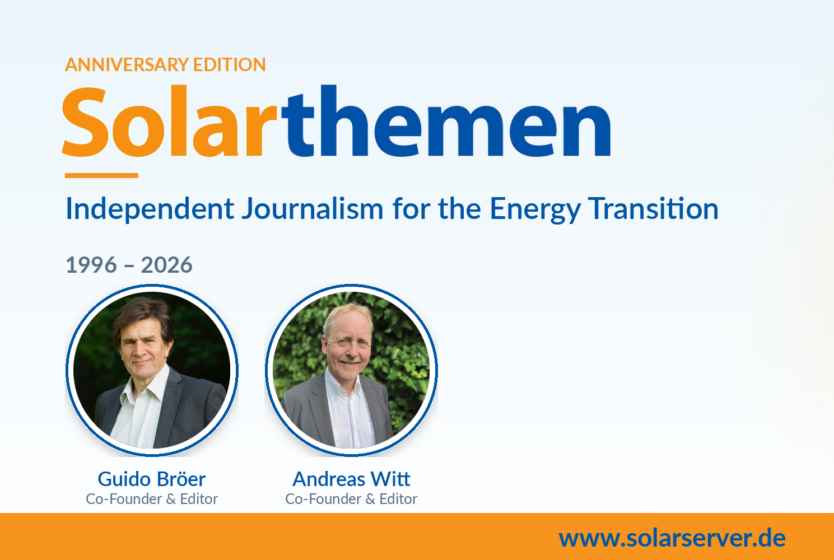
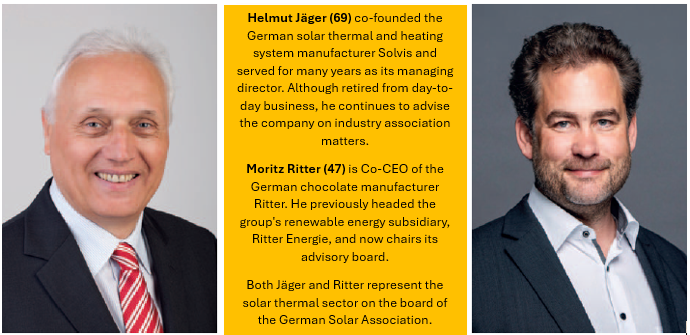
In June 2026, the German renewable energy news journal Solarthemen published its 600th issue, marking 30 years of independent journalism covering the energy transition. Founders Guido Bröer and Andreas Witt have expanded their publishing activities to include the online news portal solarserver.de and the municipal energy magazine Energiekommune. To celebrate the anniversary, they interviewed two leading experts – Helmut Jäger and Moritz Ritter – who represent two generations of solar thermal business leaders. solarthermalworld.org congratulates the two dedicated journalists on their anniversary and is pleased to republish their insightful interview in an abridged version.
Solarthemen: Mr Ritter, as a representative of what could be called the second generation of solar thermal entrepreneurs, do you still consider the term “solar thermal industry” appropriate today?
Moritz Ritter: Absolutely. I still see solar thermal as a technology with the potential to make a significant contribution to the energy transition. Germany’s largest solar thermal plant is currently being commissioned, with 65,000 m² of collector area. From an economic perspective, it is an excellent investment for the municipal utility of Leipzig. Projects of this scale require an industry behind them. And beyond Germany, solar thermal remains an important topic. Although photovoltaics has become a strong competitor, the market potential is still large enough to speak of a solar thermal industry.
Solarthemen: Let us ask someone who has experienced all the ups and downs of this industry: Helmut Jäger. In 2008, you and your colleagues installed almost 2 million m² of collectors in Germany – at the peak of the market. In 2025, the figure was only around 100,000 m², significantly lower than 30 years ago. How do you view this development?
Helmut Jäger: We have been used to a dynamic environment for more than 40 years. The key factor is that Solvis has always adapted to changing market conditions and remained flexible. We started in 1982 with very simple systems for heating outdoor swimming pools. We then moved into the heating sector – not because it had been part of our original long-term strategy, but because it became a necessity to differentiate ourselves from low-cost competitors. Later, we combined heating and solar technology in one system, the SolvisMax. We also began integrating heat pumps as early as the beginning of the 2000s.
Solvis has always adapted to market developments at the right time. We continue to work on innovations, so I am not discouraged. The important thing is to stay alert, anticipate developments and position yourself accordingly. Then the business can succeed.
“Political framework conditions are much more responsible for the current situation than any technological change”
Solarthemen: This applies in a similar way to your company, Mr Ritter. It is interesting that your company occupied a niche in Germany for many years with vacuum tube collectors and the Aqua system, but in 2025 you suddenly became the market leader. Mainly thanks to two large-scale projects, the Ritter Group supplied more than half of all collector area installed in Germany that year – albeit in a dramatically smaller market. How much do you appreciate this achievement?
Moritz Ritter: Not very much, to be honest. Of course, being market leader is a positive achievement. But I would much rather see a significantly larger market with more market participants. We had some very successful years, and then regulatory uncertainty caused major disruption. This affected the entire heating market, of which solar thermal is a part, and cut it in half.
This has nothing to do with the technology itself. In my view, political framework conditions are much more responsible for the current situation than any technological change. I still see excellent prospects for solar thermal – including in combination with heat pumps or as part of PVT systems.
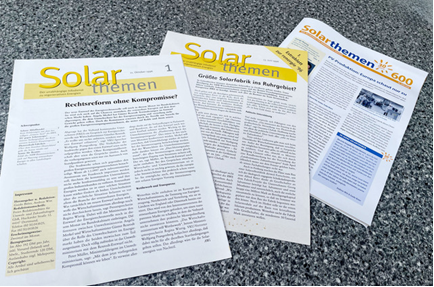
600 editions of the German news magazine Solarthemen were published in the last 30 years Photo: Solarthemen
Solarthemen: Speaking of politics: What can the solar thermal sector do to become less dependent on political decisions? When Solarthemen was launched in 1996, the German Solar Energy Association (DFS), where you were active at the time, Mr Jäger, was already arguing that subsidies should gradually decrease and would no longer be needed after a few years. The fact that 30 years later we still have support schemes – probably stronger than ever – could be seen as a sign of the sector’s continued dependence on politics.
Helmut Jäger: Yes, we have two types of dependency. The first is dependence on politics. We cannot ignore political decisions – and this is not unique to solar thermal. It also applies, for example, to the biogas and geothermal sectors. There are numerous studies showing that biogas could be more cost-effective than conventional gas-fired power generation, yet this is often disregarded for political reasons.
The second dependency is linked to energy prices. In 2008, oil prices rose dramatically due to supply constraints and market speculation. This contributed to the rapid growth of the solar thermal market. However, when we look at support schemes, it becomes clear that solar thermal has been disadvantaged compared with photovoltaics for decades. Solar thermal has received support equivalent to a maximum of around 3 €-cent/kWh, whereas photovoltaics benefited from feed-in tariffs up to ten times higher in the past and still receives almost twice as much guaranteed support today. This represents a major competitive disadvantage.
“We need to maintain a broad product portfolio”
Solarthemen: I would like to repeat the previous question: What can companies do to become less dependent on political influences?
Helmut Jäger: We have drawn the conclusion that we need to maintain a broad product portfolio. If a customer wants a conventional oil or gas heating system, we can provide one – but always integrated with a storage system and with the option of adding solar technology later.
This broad positioning has allowed us to adapt relatively well to market fluctuations. Nevertheless, we have experienced all the highs and lows of the market.
Moritz Ritter: We have taken a similar approach. Apart from oil systems, we offer a broad range of heating solutions. However, if the heating market as a whole is cut in half, no matter how broadly you position yourself, the impact cannot be avoided.
Companies cannot become completely independent of the overall market environment, which also includes subsidy schemes. Support programmes create market momentum and influence public perception. In fact, perception can sometimes be even more damaging than the actual framework conditions. When media reports suggest that heating subsidies no longer exist or that their future is uncertain – as is currently the case – consumers become reluctant to invest. This affects the entire heating market, regardless of the technology involved.
Solarthemen: When we launched Solarthemen 30 years ago, you, Mr Jäger, were already active as a solar pioneer. Your father, Mr Ritter, was also among the early pioneers of solar energy. Later, major heating manufacturers entered the market, produced their own collectors and dominated the solar thermal sector for several years. Today, the situation has changed again. For large heating companies, solar thermal no longer appears to play a major role. Is this an opportunity for specialised companies and committed pioneers?
Helmut Jäger: I would not see it that way. It is actually a problem when a technology loses visibility and attention. Historically, no more than 20 to 30% of heating installers actively sold solar thermal systems. Others only offered them when customers specifically requested them.
Today, I estimate that the share of installers who are truly committed to solar thermal is only around 10 to 20%. If the overall market continues to shrink, this affects everyone. We lose the opportunity to achieve cost reductions through higher production volumes and learning effects. That is a challenge for the technology as a whole.
“Very attractive market window for large-scale solar thermal systems”
Solarthemen: Heating with photovoltaics – is this a topic for your companies?
Helmut Jäger: We offer photovoltaic systems, particularly in combination with heat pumps. Many customers who can afford it are looking for a complete package combining PV and a heat pump. We do not generate major revenues from photovoltaics, but we certainly include it in our portfolio.
Moritz Ritter: We also offer photovoltaic systems. Around ten years ago, we introduced a direct solution using an electric heating element because it is simple and cost-effective. However, if homeowners want to maximise the energy yield from their roof, combining photovoltaics and solar thermal makes sense. Depending on the technology used, solar thermal can deliver two to three times more energy per square metre.
This is because customers also want to use PV electricity to charge electric vehicles and home batteries, which makes roof space a limiting factor.
Solarthemen: You mentioned earlier that you see a future for solar thermal. Where do you see the technology in 30 years?
Moritz Ritter: For me, it is clear that photovoltaics will continue to advance significantly, driven by enormous research and development efforts and substantial investment in efficiency improvements. Solar thermal, in contrast, is already very advanced in terms of efficiency, so there is less room for further gains.
And electricity – we should not ignore this – is much more versatile than heat. Therefore, I believe photovoltaics will eventually catch up with solar thermal in terms of energy yield per unit of area. However, this will still take some time.
Until then, there is a very attractive market window for large-scale solar thermal systems and for residential applications where homeowners want to maximise the use of limited roof space. These are the two main markets where I see the strongest future potential for solar thermal.
Websites of organisations mentioned in this news article:
Test the Solarthemen subscription: https://www.solarserver.de/solarthemen-infodienst-testen/#
Solarserver: https://www.solarserver.de/
BSW Solar: https://www.solarwirtschaft.de/en/home/
Solvis: https://www.solvis.de/
Ritter Energie: https://ritter-energie.de/