PVT collectors and ice storage heat sustainable district in Luxembourg
November 9, 2026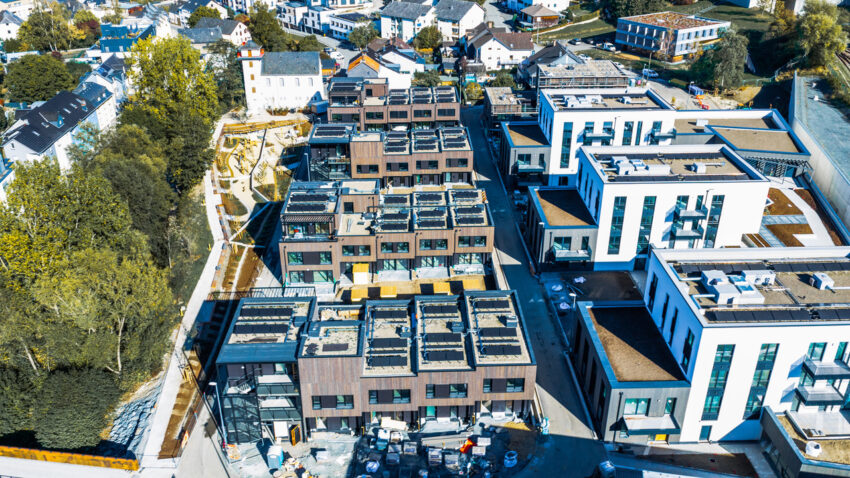
A new residential district is currently taking shape in the small town of Wiltz in northern Luxembourg. Its heating supply will rely entirely on PVT collectors, ice storage systems and heat pumps. In the sustainable neighbourhood of Wunne mat der Wooltz (Living with the Wooltz River), a total of 3,000 PVT collectors manufactured by German company Consolar Solare Energiesysteme will gradually be installed on various buildings. The photograph shows block 2 of the development, comprising single- and multi-family residential buildings that are already in operation and equipped with 754 m² of PVT collectors. In early October, Consolar invited around 50 experts from six countries to visit the construction site and learn more about the project’s sustainable energy supply.
Photo: Consolar
The development is intended to serve as a flagship project for sustainable urban planning, low-impact mobility and energy neutrality. Over the coming years, the 34-hectare former industrial site will be transformed into a mixed-use neighbourhood comprising 1,085 homes, retail premises, community spaces, service-sector offices, green spaces and playgrounds. A new school campus is already operational. The project is being developed by the Municipality of Wiltz and Luxembourg’s Fonds du Logement.
The PVT collectors, together with the ice storage systems, will serve as the sole heat source for the brine-to-water heat pumps supplying the buildings with heat. “Our SOLINK collectors harness not only solar radiation but also ambient air as a heat source, allowing them to operate at night and during winter,” explained Andreas Siegemund, Managing Partner responsible for Marketing and Export at Consolar. The supplier describes its SOLINK collectors as “an example of European-developed High Solar Tech that contributes to strengthening the EU’s energy independence”.
During the site tour, Siegemund also highlighted an important design difference between SOLINK collectors and conventional air-source heat pumps.
In conventional air-source heat pumps, the fins of the outdoor unit’s heat exchanger are typically spaced just 2 to 4 mm apart, while a fan continuously draws outdoor air through the unit. In humid weather at temperatures just above freezing, the heat exchanger can ice up rapidly, requiring regular defrosting cycles. Each cycle consumes additional energy, increasing electricity demand. “Our SOLINK collectors have a fin spacing of around 10 mm and operate without a fan. When installed in a parallel-roof configuration, no defrosting cycle is required,” Siegemund explained.
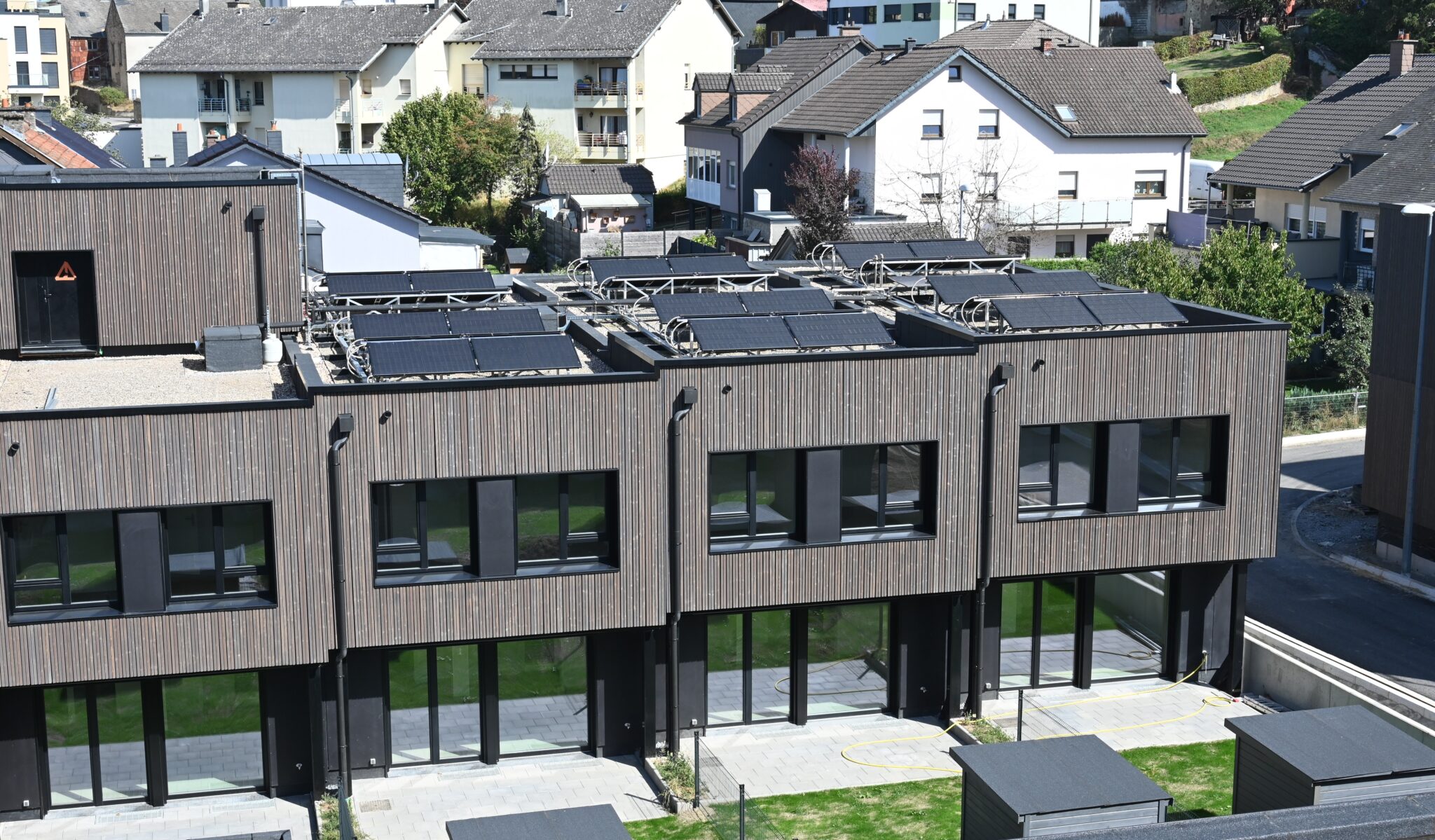
Completed PVT installations on single-family homes in the Geetz neighbourhood, part of the Wunne mat der Wooltz development in Wiltz, Luxembourg. PVT technology offers two particular advantages in densely built residential areas: the systems operate silently and require no additional space in gardens or courtyards. Photo: Consolar
Ice storage systems regenerated by PVT heat in summer
An important element of the heating concept is a low-temperature energy network connecting the thermal storage units and enabling energy exchange between different sections of the neighbourhood. Compared with conventional high-temperature district heating systems, this approach can reduce distribution losses. A total of eight underground ice storage units, each housed in a concrete tank are planned across the entire development.
The brine-to-water heat pumps can draw energy directly from the SOLINK PVT collectors, from the network, or from both sources simultaneously. The choice depends on the relative temperatures in the PVT circuit and the network, with a defined bivalence point determining which source is used.
Depending on demand and operating conditions, the PVT collectors therefore supply heat either directly to the heat pumps or to the network, where it is used to regenerate the ice storage systems.
The low-temperature network interconnects the ice storage units serving the individual neighbourhood sections. During cold, overcast winter days and at night, the low temperature heat network can draw energy from the ice storage systems. A cold brine solution is pumped through pipes inside the storage tanks, extracting the so-called latent heat of fusion released as the water freezes.
Low-temperature heat network: A year-round heat source for decentralised heat pumps
During summer, heat from the PVT collectors is transferred through the network to regenerate the storage systems. In addition, the system harnesses geothermal energy through the uninsulated underground pipes connecting the storage units with the heating centres. These pipes allow heat exchange with the surrounding ground.
During winter, temperatures in the low-temperature network remain sufficiently stable to ensure efficient heat pump operation. Over the course of the year, network temperatures are expected to range from approximately 0 to 25 °C.
The heat pumps will not be used for active cooling in summer. Thanks to the high insulation standards of the new buildings in the neighborhood, air conditioning is not planned. This also avoids potential conflicts between heating and cooling requirements in the energy network.
As a result, network temperatures can rise during summer, allowing excess PVT heat to be used for ice storage regeneration. There is no need to impose an upper temperature limit to accommodate active cooling operation, as would otherwise be necessary to ensure efficient heat pump performance in cooling mode.
The sustainable energy concept was developed in collaboration with Belgian engineering consultancy Goblet Lavandier & Associés and implemented under the leadership of Belgian engineering firm Greisch.
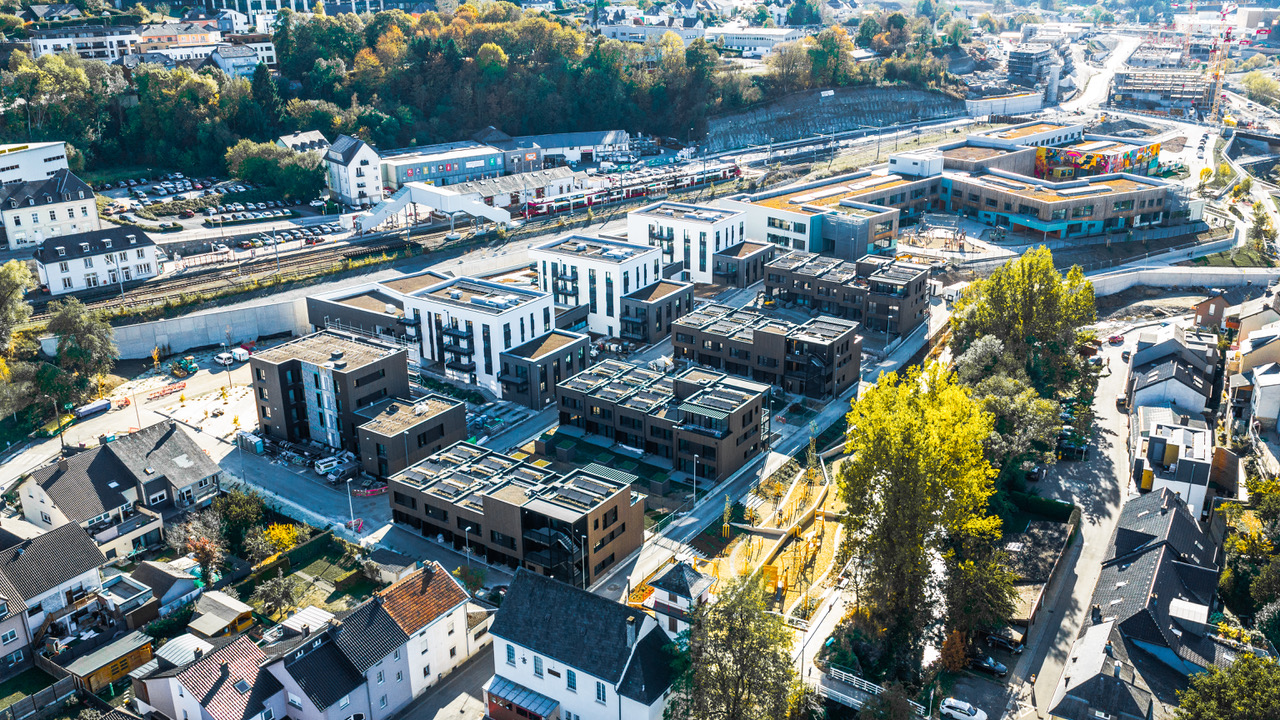
Wunne mat der Wooltz: The 34-hectare development stretches along the river through the valley. Photo: Consolar
Websites of organisations mentioned in this news article:
Consolar Solare Energiesysteme: https://www.consolar.de/en/home_en/
Neubaugebiet Wunne mat der Wooltz: https://wmdw.lu/
Fonds du Logement: https://fondsdulogement.lu/fr
Goblet Lavandier & Associés: https://www.golav.lu/en/experience-and-innovation