IEA SHC Task 73 tackles the challenge of testing transpired air collectors
June 5, 2026
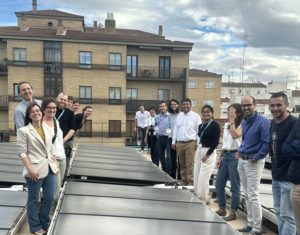
PVT collectors that use air as the working fluid are being evaluated within IEA SHC Task 73 entitled PVT Heating Systems. They can preheat ventilation air in buildings while producing electricity, as demonstrated by the installation at John Molson School of Business at Concordia University in Montreal, shown in the photograph above. Most rely on extracting air through perforated (transpired) panels mounted behind PV panels. The performance of these collectors, however, depends on many factors, both atmospheric and operational. Product ratings and design tools therefore need to be revised to accommodate these factors. Key to this effort is understanding how transpired air collectors perform independently and whether suitable procedures exist for characterizing new products in accordance with accepted international standards. Currently, they are not fully covered by the collector norm EN ISO 9806 or the US Standard ICC 901/SRCC 100.
Within Task 73, the Canadian company QSBR Innovations and Queen’s University in Canada are working on filling this gap. The idea is to identify a testing protocol that accurately evaluates the performance of transpired air collectors across a range of typical conditions. The goal is to evaluate whether ISO’s dynamic test method can be adapted to characterize transpired collectors for product ratings and the performance validation of large-scale installations. We discussed these activities with Dr Stephen Harrison, Professor (Emeritus) at Queen’s University, and Korbinian Kramer, Manager of Task 73.
Why are unglazed, open-loop transpired air collectors not fully covered by the collector norm EN ISO 9806?
Harrison: ISO 9806 specifies a test method for “open to ambient” air-heating WISC (Wind and Infrared Sensitive Collectors) but does not specifically address transpired air collectors. These draw air through small perforations, usually distributed evenly over the absorber surface and are fundamentally different from open-to-ambient collectors that intake ambient air through a single opening. Consequently, airflow through the transpired absorber plate and temperature profiles differ, affecting heat transfer coefficients. As the air flow rate through the transpired absorber increases (i.e., the “suction velocity”), the outer surface air boundary layer may be sucked into the absorber, reducing wind influence and lowering heat losses.
Kramer: In addition to the mentioned specifics of transpired collectors, open-to-ambient collectors face the drawback of not being described with a full set of collector equation parameters. Their performance is only evaluated at a single operational condition, and that limits the accessibility of those collectors in simulation programs. A significant disadvantage.
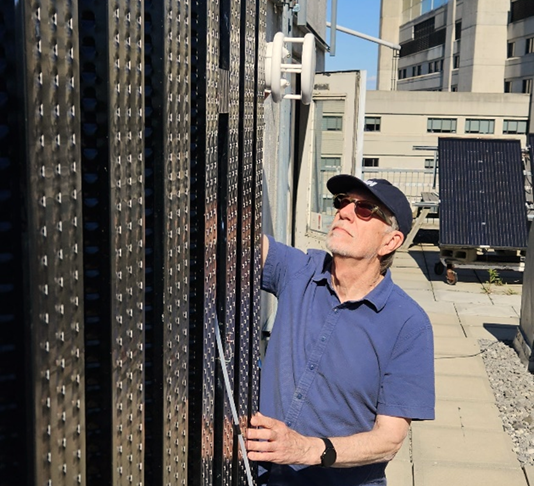
Dr. Stephen Harrison oversees the research project as part of the Task 73 work. Photo: QSBR Innovations
So what are the research goals of your work within Task 73?
Harrison: We would like to fill the gap for transpired collectors in ISO 9806:2025. The idea is to modify recognized test and rating methods – especially the ISO Dynamic Test method – to include key parameters for open-to-ambient-air collectors, including transpired collectors. Another objective is to compare test results obtained on small-scale transpired collector samples with those derived on large full-scale systems. It is important to establish if it is possible to extrapolate lab test results to large-scale transpired air collector installations. But further studies are required to verify the applicability of this extrapolation.
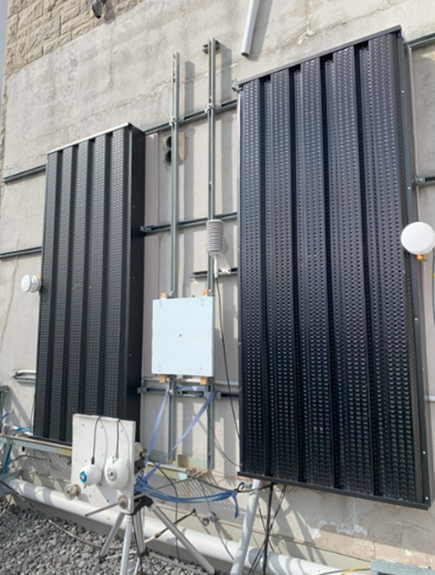
Outdoor test facility at Queen’s University for testing small-scale transpired collector samples under varying climate and operational conditions. Multiple anemometers, radiometers, and temperature and humidity sensors are used to collect detailed performance data over spring, winter and fall periods. Photo: Queen’s University
Which steps have you taken so far to fulfill your goals?
Harrison: Initially, we installed small-scale transpired collector samples outdoors that could be operated over a wide range of operational and weather conditions. Using extensive meteorological instrumentation, we can identify key parameters that affect performance and incorporate them into an improved test method and characterization, thereby improving product comparisons and system performance predictions. In our research, a special focus was on the effects of wind, longwave radiation exchange, and flow rates on performance.
The collector norm allows steady-state tests and dynamic test methods. Which one do you recommend for transpired air collectors?
Harrison: In the past, steady-state tests were primarily used, but these required substantial investments in test facilities to accurately simulate outdoor conditions. Dynamic test methods can be performed outdoors under realistic conditions but may require longer test periods to quantify the sensitivity to key parameters. If dynamic test methods are developed for transpired collectors, they could be cost-effective and also applied to full-scale systems to verify performance.
Kramer: Exactly. When testing small samples on test rigs, the influence of the edges on the air flow patterns and losses is more dominant. The quasi-dynamic method can allow for ”in-situ” that means on-site evaluations. We have had very good experiences with in-situ qualifications in the past years. It ..remains an innovative methodological approach, though. Within the task, the sharing of monitored data from several air-system integrators is planned, which is a great opportunity.
Did the results of your first façade collector tests confirm that you can use the dynamic test method for transpired collectors?
Harrison: Yes, indeed. Our initial tests indicate that the dynamic test method is feasible and superior to current steady-state methods for identifying key parameters and product-specific performance. The success of the method relies on a general characterization equation whose coefficients are determined by statistical analysis on a comprehensive data set.
Kramer: To measure the energy increase over such a collector, it is essential to balance all incoming and outgoing energy fluxes. As air is a compressible medium, accounting for non-uniform temperatures and flows is more challenging than in water-based tests. The humidity of the air has a significant effect on energy capacity; this is evident in the many studies published today, and experiences from air-heating solar collectors are, in that regard, transferable.
Which parameters are important for testing transpired air collectors?
Harrison: The preliminary results indicate that the performance of transpired air collectors depends strongly on four parameters, among them air flow rate (i.e., suction velocity), solar and thermal radiation exchange, and wind direction. Previous studies have also shown that design details such as air-channel depth are significant.
So how does this relate to air-based PVT collectors?
Harrison: A variety of transpired air collector manufacturers are configuring PVT systems by placing PV panels above transpired collectors to reduce PV temperature and harvest thermal energy. Adding PV modules will certainly affect the thermal effectiveness of the transpired absorber located below it. The size of the air gap between the absorber plate and a PV panel is important.
But we are optimistic that the lessons learned from testing transpired collectors can be applied to these PVT designs. A better understanding and characterization of specific collector design features should lead to the improved performance of transpired PVT collectors, but such specific design features would require additional parametric or analytical evaluation. We hope to address these in the future.
Kramer: Yes. Conducting this work within IEA Task 73, PVT Systems, significantly contributes to the overall program and understanding of PVT transpired collectors and systems. And of course, “non PVT” air heating collectors will profit from this development as well.
Websites of organizations mentioned in this news article:
Task 73 PVT Heating Systems: IEA SHC || Task 73 || PVT Heating Systems
Concordia University: Concordia University
QSBR Innovations: QSBRI – Home
Fraunhofer ISE: Forschen für die Energiewende – Fraunhofer-Institut für Solare Energiesysteme ISE – Fraunhofer ISE
Solarwall: Solar Powered Heater, Solar Air Heating System – SolarWall