No gas needed on sunny days: Belgian parabolic trough field delivers 295 °C solar process heat
July 14, 2026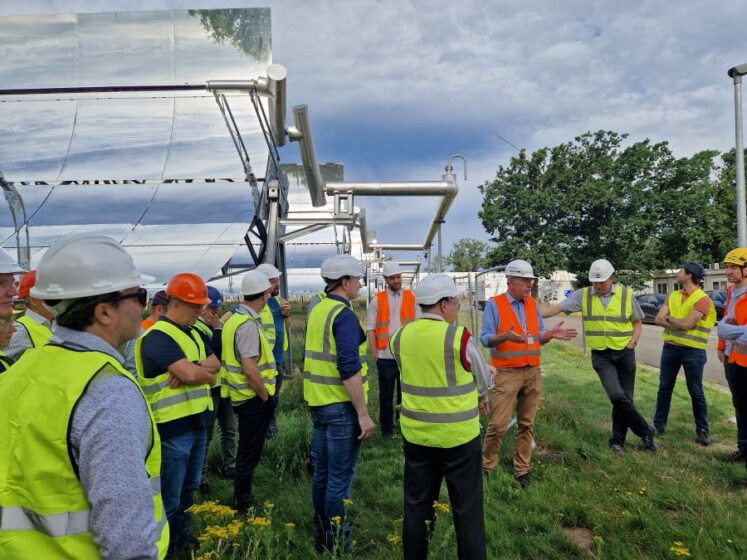
One of Central Europe’s most innovative demonstration projects for solar process heat was the destination of a technical visit offered by the German Aerospace Center (DLR) as part of the German research project ProSolNetz: the parabolic trough collector plant at Avery Dennison’s manufacturing site in Turnhout, Belgium. As Germany does not yet have a comparable parabolic trough system in operation, the visit attracted considerable interest, with all 25 available places filled shortly after registration opened. On sunny days, the solar field produces thermal oil at temperatures of up to 330 °C, supplying the entire heat demand of Avery Dennison’s production process. During these periods, the site’s gas-fired boilers can remain switched off. Photo: solrico
The local host of the technical visit was Campina Energie, the energy cooperative that owns and operates the concentrating solar thermal plant. Founded in 2013, Campina Energie has grown to 2,600 shareholders and has made a total installed investment of EUR 14 million – mostly in PV and wind plants.
“We are extremely pleased with our collaboration with Campina Energie because it gives us unrestricted access to the installation for research purposes,” said Dirk Krüger, ProSolNetz project manager and researcher at DLR. “This allows us to investigate topics such as the impact of mirror cleaning on system performance and opportunities for operational optimisation.”
The plant has entered regular operation in March 2026. “The major troubles are solved now, the system is running smoothly”, confirmed Jos de Groote, Member of the board of directors of Campina Energie and the O&M manager of the solar field. “We are now entering the next phase and this is monitoring the output and continuous improvement of the efficiency”.
Following Campina Energie’s acquisition of full ownership of the plant in January 2026. Back then the cooperative also signed a new heat supply agreement with Avery Dennison. It is a global manufacturer of adhesive materials and labelling solutions, operating around 180 production facilities worldwide with its headquarters in the United States. The Turnhout factory produces adhesive materials 24/7.
The parabolic trough collector field was installed in 2023 by Sunnacalor, a joint venture between the former Azteq Group and Campina Energie. However, the insolvency of Azteq in December 2024 delayed the project’s commissioning, as legal and technical issues related to the installation first had to be resolved.
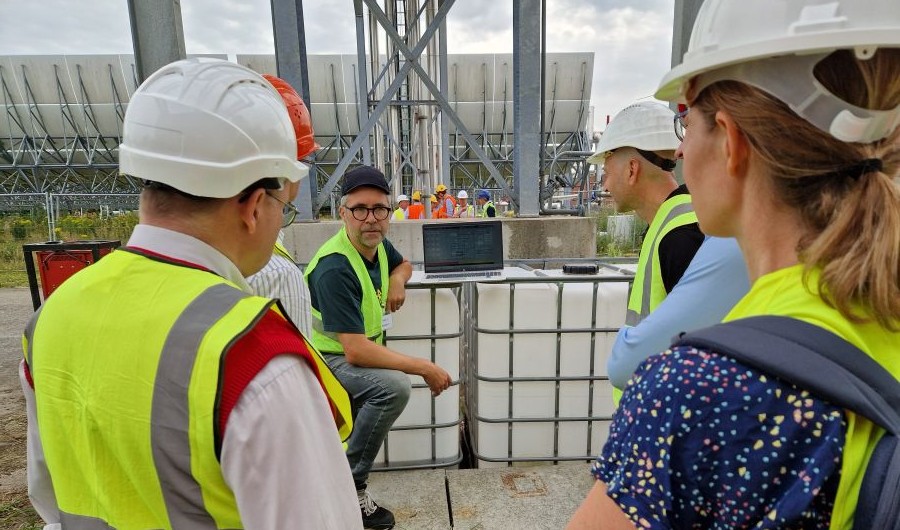
Figure 1: Bram van Dun of Campina Energie demonstrates the plant’s daily performance. The system responds rapidly to sunlight, increasing the fluid temperature by up to 30 °C within minutes. Photo: solrico
| Site | Turnhout, Belgium |
| Gross collector area | 5,540 m2 |
| Thermal capacity of collector field | 2.5 MW |
| Collector type | Parabolic trough collector |
| Owner of the collector field | Campina Energie, Turnhout |
| Heat offtaker | Avery Dennison, Turnhout |
| Term of heat supply contract | 20 years |
| Total investment costs for solar field without storage and without balance of plant | EUR 1.4 million |
| Specific costs of the solar field | 253 EUR/m2 |
| Public funding of Flemish government | EUR 1 million |
| Supply temperature of solar field | 280 to 330 °C |
| Heat transfer fluid in solar circuit | Silicon oil of the type Heliosol 5A |
| Supply temperature to client | 295 °C (capped by the temperature resistance of the thermal oil used in the factory) |
Technical data of the parabolic trough collector field in Turnhout, Belgium Source: German Aerospace Center/Camina Energie
EuroTrough: a mature collector technology for medium-temperature process heat
During the site tour, participants from industry, engineering companies, research organisations and trade associations showed great interest in the technology. For many of them, it was the first opportunity to see a parabolic trough collector system for industrial process heat operating in a real production environment, prompting lively discussions and numerous technical questions.
The solar field consists of 80 EuroTrough collectors, each with an aperture area of 69 m² (12 m × 5.76 m) – which is the typical size also of collectors in concentrating solar power plants. Mostly rows of six collectors are driven by a single hydraulic unit to track the sun. The Turnhout installation comprises three collector loops. Within each loop, all collectors are connected in series, allowing the heat transfer fluid – a high-performance silicone oil of the Helisol type – to flow through a total of at least 288 m of receiver tube before reaching the balance of plant.
The EuroTrough collector was originally developed between 1998 and 2002 by Schlaich Bergermann and Partners and has since been deployed in numerous commercial concentrating solar power plants. The collectors were assembled locally in Turnhout with the key components like Receivers and mirrors shipped from Huiyin Group in China.
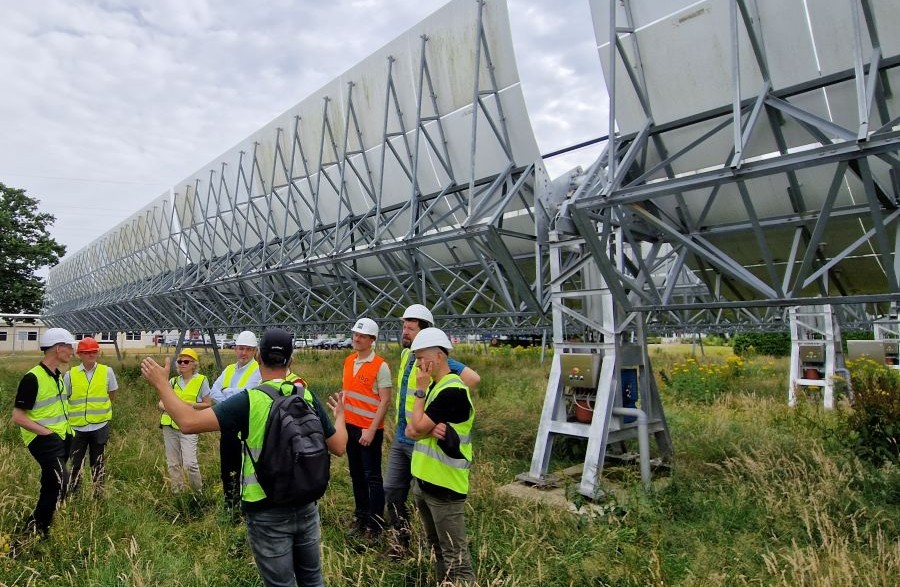
Figure 2: Triangular galvanized steel trusses on the rear side provide structural stiffness for the mirrors. They support the cantilever arms, which are connected to mounting pads bonded to the back of the mirrors. One hydraulic drive unit tracks the sun for a group of six EuroTrough collectors or more, each with an aperture area of 69 m². Photo: solrico
Mirror support structure and plant integration
The key components of the collector are the curved glass mirrors, which are delivered to the site ready-formed. To realise the parabolic profile, two different mirror shapes are used. The mirrors are mounted in a symmetric position on top and below the central line of the collector. The inner mirrors have a smaller radius of curvature than those installed in the outer sections of the trough. Structural rigidity is provided by triangular galvanized steel trusses. These support the cantilever arms, which are attached to ceramic mounting pads bonded to the rear surface of the mirrors.
“We have cleaned the mirrors only once so far, in February 2026,” explained Bram van Dun during the site tour. “We used just 8,000 litres of demineralized water, equivalent to only 1.5 litres per square metre of mirror aperture. Based on our experience so far, cleaning the mirrors once a year offers the best balance between performance and operating costs.”
The shell-and-tube heat exchanger is the central component of the balance of plant, transferring heat from the collector’s primary loop to the customer’s process heat circuit. At the Turnhout facility, the thermal oil in the customer circuit is heated to a maximum of 295 °C to prevent thermal cracking of the oil used in the factory. “During start-up, the heat transfer fluid is initially circulated through a bypass loop to prevent cold fluid from entering the factory’s heat supply network,” explained Krüger (see Figure 3).
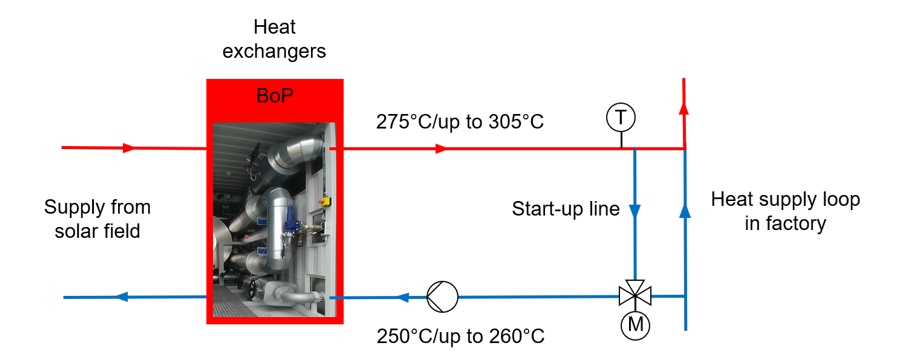
Figure 3: During start-up, a bypass line allows the solar-heated heat transfer fluid to circulate until the required temperature for the customer’s heat network is reached. The secondary circuit pump is activated once the primary-side inlet temperature at the heat exchanger reaches 250 °C.
Graphic: German Aerospace Center
According to Krüger, the plant now operates highly reliably and almost entirely automatically. Campina Energie provides the ProSolNetz consortium with operational data recorded at five-second intervals for performance analysis and research. Figure 4 presents measurement data from 29 April 2026, a clear and sunny day. The green dotted line shows the temperature supplied to the customer’s heat network, which remains remarkably stable at the target value of 295 °C throughout the day.
Operational data provided by Avery Dennison for the same day show that the gas-fired boilers were switched off before 8:00 am and remained offline until shortly after sunset at around 7:00 pm. “Throughout this period, solar energy supplied 100% of the factory’s heat demand,” Krüger emphasized. However, the customer was not able to absorb the full thermal output of the solar field at all times. As a result, roughly half of the solar collectors are defocused to reduce the solar field power avoiding overheating. The jagged red double line represents the thermal power in the solar circuit which follows the demand curve between 8:00 am and 7:00 pm. Its fluctuations reflect variations in the factory’s heat demand, which change throughout the day depending on the industrial processes in operation.
The Turnhout installation is therefore a particularly valuable facility for demonstration and research. Its exceptionally high solar fractions require the plant to closely match the customer’s dynamic heat demand on sunny days, providing valuable operational experience for future medium-temperature solar process heat systems.
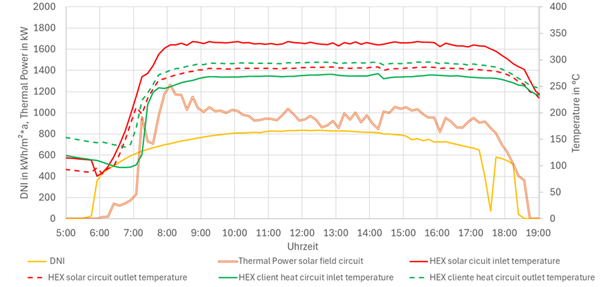
Figure 4: Processed measurement data from the parabolic trough plant in Turnhout on a sunny 29 April 2026 Graphic: German Aerospace Center
Websites of organisations mentioned in this news article:
German Aerospace Center: https://www.dlr.de/en
Campina Energie: https://campinaenergie.be/
ProSolNetz: https://www.solarwirtschaft.de/unsere-themen/csp/prosolnetz/
Avery Dennison: https://www.averydennison.com/en/home.html
Huiyin Group: http://huiyin-group.com/