Germany’s largest solar district heating plant starts operation in Leipzig
July 9, 2026
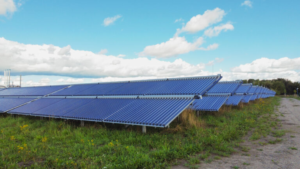
The new solar district heating plant in Leipzig marks another milestone for Germany’s district heating transition. With 45.6 MW the installation ranks as the fourth-largest solar district heating plant worldwide and is by far the largest in Germany. Leipzig’s municipal utility Stadtwerke Leipzig and German solar thermal specialist Ritter XL Solar have officially inaugurated the plant on 17 June 2026. Following more than two years of construction, the facility in the western part of Leipzig has started commissioning and is expected to enter continuous operation during summer 2026.
Photo: Stadtwerke Leipzig
For Stadtwerke Leipzig, the installation is another building block in its strategy to decarbonise heat supply and phase-out of coal-based generation. The utility has been pursuing an extensive transformation programme including a power-to-heat system and industrial waste heat.
Karsten Rogall, Managing Director of Stadtwerke Leipzig (fourth from left on the top photo), is quoted in the press release sent out by Ritter XL Solar that sustainability means combining climate protection with security of supply. The solar thermal plant strengthens the resilience of Leipzig’s heat portfolio while increasing the share of renewable energy in the district heating system.
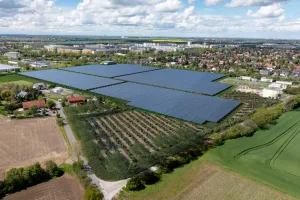
Located on a 13-hectare site in Leipzig’s Lausen-Grünau district, the system is expected to generate approximately 29 GWh of heat annually. On average, the new solar thermal plant will meet around 2% of the city’s annual heat demand. During sunny summer days, however, its contribution will be substantially higher, reaching a solar fraction of up to 20%.
Leipzig’s district heating network delivers around 1,500 GWh of heat each year to approximately 4,000 clients in the property sector, 400 commercial customers, 500 private households, and 400 public buildings, including schools and sports halls.
Investment costs and performance assurance
The total investment for the entire solar plant, including the technical building and connection to the local district heating network, amounted to around EUR 40 million. The specific costs therefore stand at 615 EUR per square metre of collector field. However, Ritter XL Solar emphasized that, prices strongly depend on the local conditions. Due to the immediate proximity of a district heating pipeline large enough to accommodate the feed-in, the conditions in Leipzig were relatively favourable in terms of costs.
Ritter XL Solar has contractually agreed to provide an energy yield guarantee to Stadtwerke Leipzig. Such guarantees are always project-specific and generally apply for the first five years. To determine the guaranteed yield, Ritter XL Solar uses an in-house developed simulation tool to estimate the energy production of the solar field under the applicable boundary conditions. A safety margin is then deducted from the simulated yield to establish the guaranteed value.
This value is not a fixed amount but is adjusted according to the actual solar irradiation. If the measured solar irradiation is lower than the irradiation assumed in the simulation, the guaranteed yield is reduced proportionally. Conversely, if the guaranteed yield is not achieved under the adjusted irradiation conditions, Ritter XL Solar is required to pay a contractual penalty for each megawatt-hour of the shortfall.

With 45.6 MWth the new district heating plant in Leipzig is the sixth largest solar heat plant worldwide and the fourth largest solar district heating plant Graphic: Solar Heat Worldwide
| Site | Lausen-Grünau, Leipzig West, Germany |
| Ground area of solar field and technical house | 13 hectare |
| Gross collector area | 65,208 m2 |
| Thermal capacity of collector field | 45.6 MW |
| Thermal capacity/ground area | 3.5 MW/hectare |
| Collector type | Vacuum tube collectors |
| EPC of solar district heating plant | Ritter XL Solar, Germany |
| Total length of pipework installed in the collector field | 44 km |
| Expected solar yield | 29 GWh |
| Specific solar yield | 445 kWh/m2 und Jahr |
| Share of annual heat demand in district heating | 2 % |
| Share of heat demand during a summer day | 20 % |
| Supply temperature in district heating grid | 108 °C in winter and 98 °C in summer |
| Total investment costs for solar field, installation and technical house | Around EUR 40 million |
| Specific costs without incentive | 613 EUR/m2 |
| Public support | around 40 % of the investment |
Key figures of the new solar district heating plant in Leipzig Source: Ritter XL Solar
Advanced control technology
One of the project’s distinguishing features is its sophisticated control concept. Ritter XL Solar has implemented its operating system, which continuously measures solar irradiation in the collector field and adjusts the water flow accordingly. When solar radiation decreases, the flow velocity is reduced so that the water remains longer inside the collectors and can still reach the required temperatures of the solar district heating plant. These are up to 108°C in winter and around 98°C in summer.
The integration posed considerable technical challenges because the network experiences pressure differences between supply and return line ranging from 0 to 10 bar. Erik Jelinek, Project Manager for the solar district heating system at Stadtwerke Leipzig, explains where this pressure difference comes from. Generally speaking, pressure in the supply line is needed to push heat into the network. The more heat generators feed heat into the network in parallel – as is the case in winter, for example – the higher the pressure in the supply line rises. Conversely, when no heat is being fed into the network, the differential pressure drops to zero and circulation in die district heating grid stops.
To avoid pressure surges, the plant incorporates a hydraulic decoupling concept with two parallel pumps and a 100 m³ short-term buffer storage tank, which can temporarily store solar heat for 15 to 25 minutes before it is fed into the network. “The short-term buffer storage gives us some time, which helps us to ramp up the pumps so that we can feed solar heat into the network even when the flow pressure is already high”, explained Jelinek.

Aerial view of the local heating plant in Leipzig West. The collector field consists of two sub-fields, which are connected to the local heating network via a hydraulic decoupler with a storage capacity of 100 m³. Photo: Stadtwerke Leipzig
Construction completed after two and a half years
Construction officially started on 8 January 2024. Civil engineering and pipe installation began one month later, while the technical building was completed in December 2024. Half of the collector field had already been installed by February 2025.
The district heating connection was finalised in April 2026, and all assembly works were completed in May 2026. Continuous operation of the entire facility is scheduled for summer 2026.
The selected site in western Leipzig proved ideal because district heating pipelines and existing energy infrastructure, including the Leipzig West combined heat and power plant, are located nearby.
Combining renewable energy and biodiversity
Beyond its energy contribution, the project also aims to enhance biodiversity on the site. Most of the area beneath and between the collectors remains unsealed and will be transformed into flowering meadows with mixed hedges.
A flock of sheep will be used to maintain the vegetation low. Based on experiences from other solar thermal projects, the developers expect the area to provide habitats for rabbits, hedgehogs, insects and birds. Leipzig’s Deputy Mayor for Climate, Heiko Rosenthal, highlighted that the project demonstrates how renewable energy deployment and species protection can go hand in hand.
The inauguration of the Leipzig solar thermal plant illustrates the growing role that large-scale solar heat can play in Germany’s district heating decarbonisation. As cities across the country search for cost-effective and secure renewable heat sources, Leipzig now provides one of the most prominent examples of how solar district heating can be integrated into large urban networks at an unprecedented scale.
Websites of organizations mentioned in this news article:
Stadtwerke Leipzig: https://www.l.de/en/energy/
Ritter XL Solar: https://www.ritter-xl-solar.de/