Momentum builds for solar thermal in Poland: Major plant, new tenders and EU Project LIGHT
April 2, 2026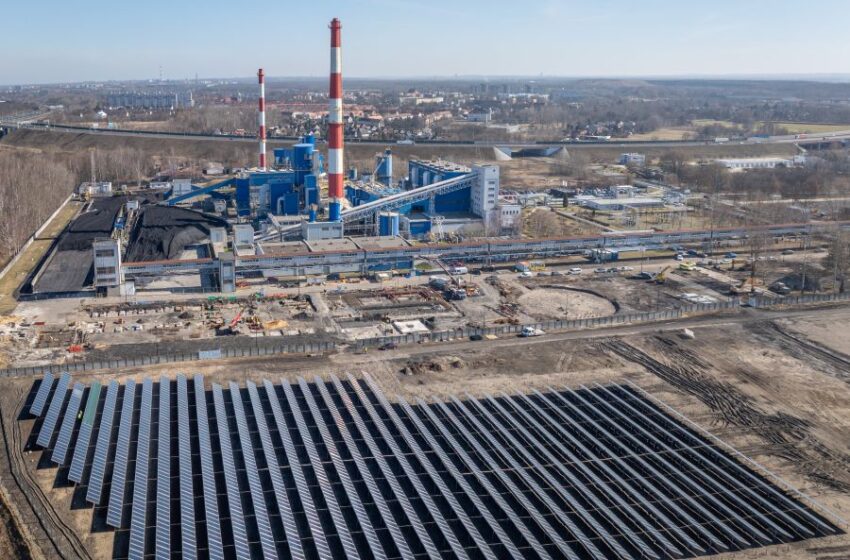
The beginning of the year has brought a series of important developments for Poland’s solar thermal sector. Construction has started on the country’s largest solar district heating plant – an 12.3 MW installation in Gliwice in southern Poland (see photo) – with more calls for tenders for similar projects expected in the coming months. At the same time, Prof. Justyna Martyniuk-Pęczek from the Gdańsk University of Technology has launched the EU-funded project LIGHT, which promotes a comprehensive approach to planning and modernizing urban areas into positive energy districts. The three-year initiative will also provide the framework for the newly established Solar Neighborhoods collaboration group under the IEA Solar Heating and Cooling Programme. Although Poland only joined the programme in August 2024, it is already proving to be a highly active member. Photo: PEC Gliwice
Martyniuk-Pęczek will lead the collaboration group on Solar Neighbourhoods. She also represents Poland on the executive committee (ExCo) of the IEA SHC Programme. “In our last ExCo meeting in November 2025 we founded collaboration groups for a number of topics. These groups will activate and develop an expert network to foster joint research activities that can then lead to a proposed new task concept”, explained Ben Stinson, IEA SHC Secretary General. If you are interested in joining the Solar Neighbourhoods collaboration group, you can contact Prof. Justyna Martyniuk-Pęczek (juspecze@pg.edu.pl).
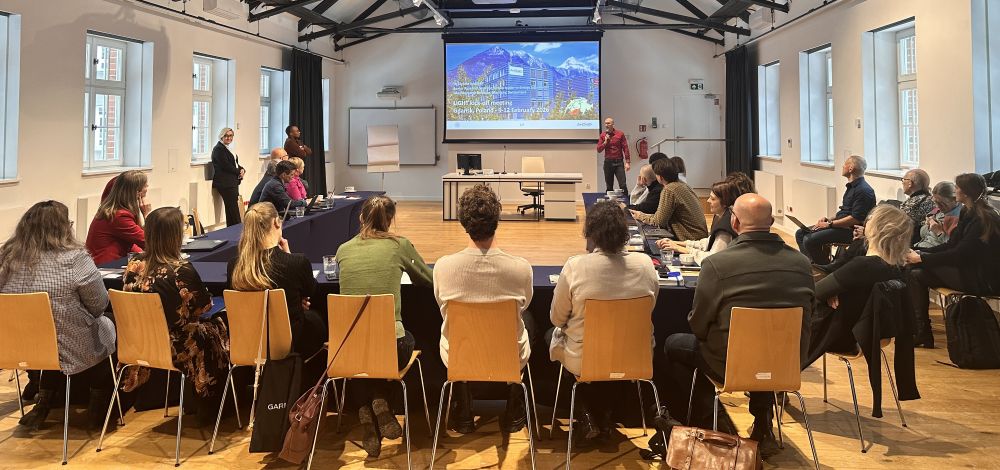
Kickoff meeting of the EU Project LIGHT at the Faculty of Architecture of the Gdańsk University of Technology on 10 February 2026 Photo: DTU
“We understand the concept of energy-positive districts not only as supporting energy transition but also contributing to health and the quality of life of residents”, explained Martyniuk-Pęczek. Hence, this approach combines energy, environmental, spatial, social and mobility goals.
One of the key elements of LIGHT will be the creation of three Urban Living Labs, where different paths for urban energy transformation will be tested and compared.
- Kartuzy in Poland will become a laboratory for energy-orientated renovation of buildings and the integration of green-blue infrastructure.
- Lund in Sweden will focus on densification and climate-neutral energy production.
- Innsbruck in Austria will develop a virtual laboratory, using parametric design to analyze urban scenarios.
Outreach activities at PowerConnect 2026 in Gdańsk
Further outreach efforts to promote the Collaboration Group were carried out during PowerConnect 2026 in Gdańsk—one of Poland’s leading events focused on energy transition and innovative technologies.
During the trade fair, Martyniuk-Pęczek represented the IEA SHC Programme, highlighting opportunities for collaboration with Polish industry and enhancing the visibility of the international research network. She also introduced the Solar Neighborhoods Collaboration Group, sharing insights into interdisciplinary approaches to sustainable, energy-efficient urban development.
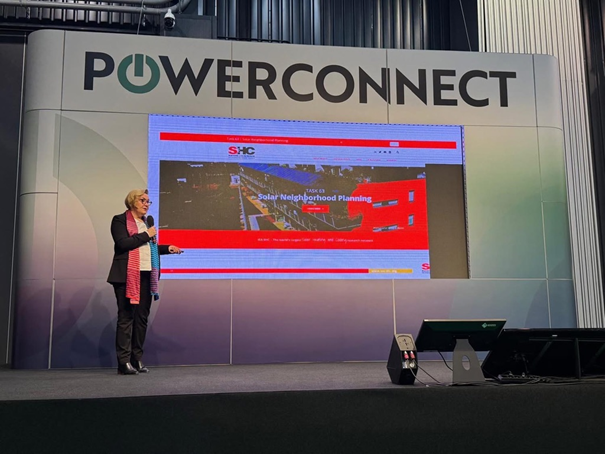
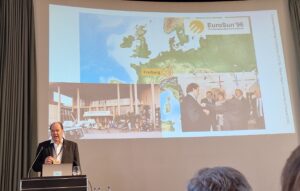
Presentation at the PowerConnect 2026 Forum in March 2026 Photo: M. Downar
Solar energy replaces 1,800 tonnes of coal for district heat in Gliwice
Progress is slow, but it is moving forward. This is especially true for the decarbonization of Poland’s vast district heating sector, which still relies heavily on coal-fired boilers. With more than 50 GWth of installed district heating capacity, Poland represents the largest district heating market in the European Union.
The Polish collector manufacturer Ensol, in cooperation with the Austrian project developer SOLID Solar Energy Systems, won the call for tenders of the energy utility PEC Gliwice for the construction of an 12.3 MW solar district heating plant in Gliwice, near Katowice in southern Poland. Altogether, Ensol will deliver 1,100 large-format solar thermal collectors each to the construction site. These are being lifted by crane onto the preassembled mounting structures (see photo below). A 90% stake in SOLID is held by the Israeli collector manufacturer Tigi.
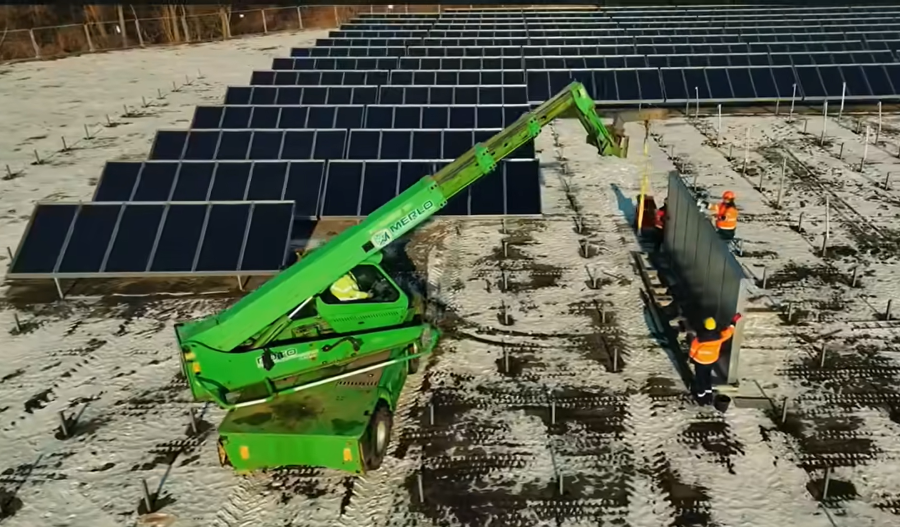
Collector field under construction near the Gliwice coal power plant Photo taken from a film published in this Linkedin Post
“Thanks to our efforts it will be easier for others who follow”
When asked about the motivation behind choosing a solar district heating plant, Krzysztof Szaliński, Chairman of PEC Gliwice, pointed to its superior land-use efficiency: “An efficiency of 25% for PV compared to 80% for solar thermal makes a significant difference, especially when available land is limited. As a company operating in the heat supply sector, the greener we become, the more acceptable we are to our customers. No smoke, no emissions, no noise – just clean, green heat.”
At present, the district heating system in Gliwice is supplied by a coal-fired power plant. According to Szaliński, the integration of solar heat production will eliminate the need to burn approximately 1,500 tonnes of coal annually. The collector field is expected to cover around 22% of the domestic hot water demand for residents during the spring and summer months. In total, about 40,000 households in
Gliwice are connected to the district heating network.
Szaliński also emphasized his role as a pioneer in advancing solar district heating in Poland. PEC Gliwice invested considerable time in preparing the project, including securing land, meeting compensatory tree-planting requirements, negotiating lease agreements and ensuring compliance with the city’s spatial development plans for the designated site. He noted that, as no such installations previously existed in Poland, the administrative authorities required extensive clarification supported by clear and well-prepared documentation.
According to Szaliński, however, the most significant challenge was “obtaining environmental approvals. Interpreting and applying water law, along with broader environmental regulations, proved demanding both for officials and for us as energy-sector professionals. But thanks to this effort, it will be easier for those who follow.”
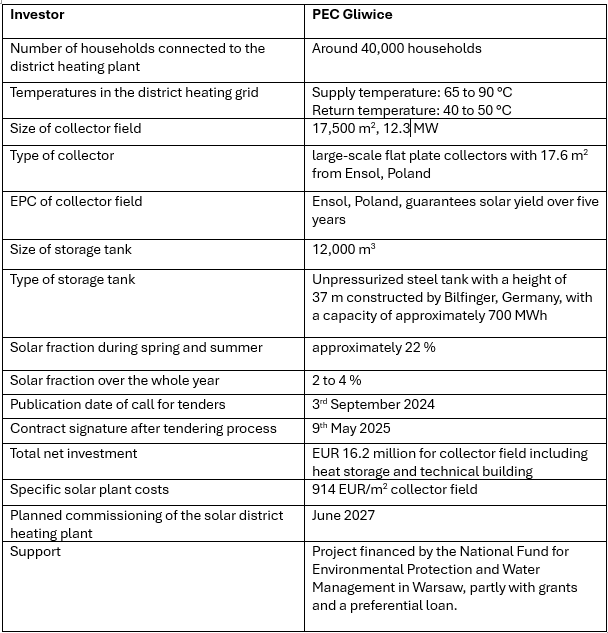
Key figures for the solar district heating plant in Gliwice. It is part of an overall EUR 86.1 million energy transition project which also includes the construction of a 21 MW waste-to-energy plant and the storage facility Source: PEC Gliwice
Decline in residential solar water heaters due to a lack of subsidies and installers
In addition to the good news from the solar district heating sector, the solar thermal market for homeowners is currently in a downward spiral in Poland. There are various reasons for this which are outlined in the report The Heating Appliances Market in Poland in 2024 published by SPIUG, the Association of Heating Appliance Manufacturers and Importers:
- The solar PV sector is booming
- There are no subsidies for solar thermal systems
- Installers who were still carrying out solar thermal installations 15 years ago are no longer active due to age, and no new installation firms are coming through.
Consequently, wholesalers are finding it difficult to recommend installers who could fit solar thermal systems. The results are shown on the graph below: In 2024, solar collectors with a total surface area of 74,890 m² were installed, which was the lowest figure in the last ten years.
SPIUG Chair Janusz Starościk summarized the situation regarding subsidies in the annual market report as follows: “Although solar thermal collectors now occupy a more visible position in the clean air programme, the lack of specific support for hybrid systems – solar collectors in combination with heat pumps and electric or biomass boilers – remains an issue. These hybrid systems are attracting increasing interest and could offer optimal investment and operating costs for many users.”
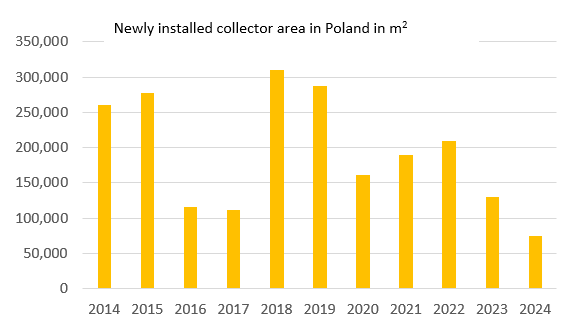
Solar thermal market development in Poland 2014 to 2024 Source: SPIUG
Websites of organizations mentioned in this news article:
IEA SHC Programme: https://www.iea-shc.org/
Technical University Danzig (TUD): https://pg.edu.pl/en
PEC Gliwice: https://pec.gliwice.pl/
SOLID Solar Energy Systems: https://www.solid.at/
Ensol: https://www.ensol.pl/de
SPIUG: https://spiug.pl/
Report The Heating Appliances Market in Poland in 2024: https://spiug.pl/raporty/spiug-report-heating-appliances-market-in-poland-2024/