Hybrid solar collector unlocks triple solar energy harvesting
December 16, 2025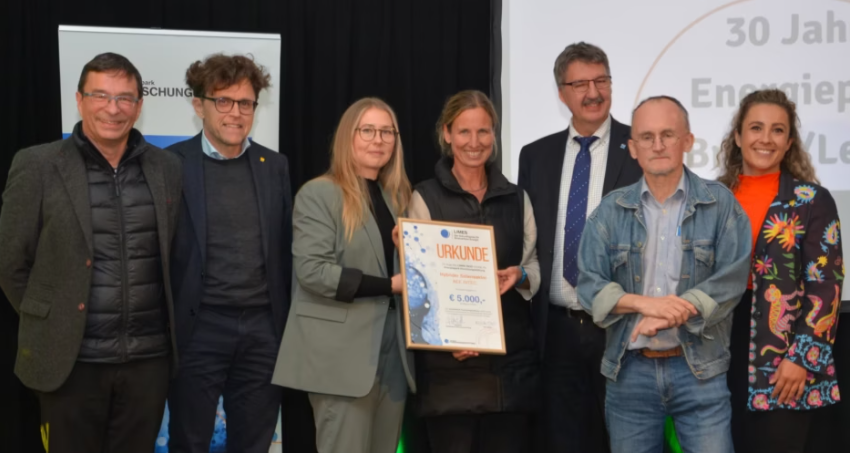
A solar collector can do more than just generate heat. As a hybrid collector, it can simultaneously produce fuel and electricity as well. Scientists from IEA SHC Task 72 are working on the development of such versatile solar elements for solar photoreactors for the production of fuels and chemicals. The aim is to maximize the utilization of the sun’s spectrum through the synergistic use of different wavelength ranges for different applications. The target is to utilize over 75% of the sunlight, a milestone in the space-efficient use of solar energy. Sarah Meitz and Bettina Muster-Slawitsch from the Austrian Institute AEE INTEC (third and fourth from left) received the newly created LIMES Future Prize 2025 for the first research concept of such a hybrid collector.
Photo: Energiepark BruckLeitha
The LIMES Future Prize 2025 showcases new ideas from young research teams. Of the five finalists, three teams received the LIMES Future Prize on 17 October – including Muster-Slawitsch’s team. “In the spring, we successfully submitted the national research project SOPHIE, which will now start in January 2026 and give us the opportunity to develop a multi-functional collector that makes optimal use of sunlight,” explained the AEE INTEC scientist. She heads the Water and Process Technology research group at AEE INTEC and also Task 72, which will run until October 2028.
Maximize the utilization of the sun’s spectrum
The SOPHIE hybrid collector targets the production of hydrogen via a photochemical process in combination with PVT collector concepts. Together with the University of Applied Sciences Upper Austria and the Technical University of Vienna, a prototype is to be developed.

Source: LIMES Future Prize 2025 / Energiepark Forschungsstiftung
SPECTRUM: Development of poly-generating collector using more efficient dual-function photocatalytic solar reactors
Task 72 supports the development of solar-to-X devices that enable photochemical reactions driven by sunlight. In such processes, solar energy is converted into chemical energy, as photons induce free electrons in the photocatalyst materials, which leads to chemical reactions. The limitation here is that photocatalysts are typically activated only by a small proportion of the solar spectrum, in its low-wavelength range. This is where hybrid collectors come into play. The collector to be developed within the SOPHIE project utilises sunlight in three ways:
- Short-wave light drives photochemical reactions, for example to produce green hydrogen.
- Medium wavelengths are used by the integrated PV cells to generate electricity.
- Long-wave light is used for thermal energy generation and ensures stable reaction conditions through active heat management.
Hybrid collector concepts are being discussed intensively within Task 72. In October 2025, a public workshop on hybrid collectors was held in conjunction with the Task 72 team meeting in Lisbon, Portugal. This workshop was organized by João Pereira Cardoso, a scientist at the Portuguese National Laboratory of Energy and Geology (LNEG), who is also working on hybrid collectors. Cardoso heads the EU project SPECTRUM.
The aim of this project is to develop and test two lab-scale prototypes for the combined generation of heat, electricity and H2 with industrial wastewater treatment. “Our research is targeting the development of poly-generating solar collectors able to produce, in a single device, electricity, heat and hydrogen, using dual-function photocatalytic reactors which can be used for both hydrogen production and industrial wastewater pollutant remediation”, said Cardoso. Substantial results are expected at the end of SPECTRUM, which will run until March 2028.
With these two research projects – SOPHIE and SPECTRUM, hybrid solar technologies are moving from vision to reality, redefining how efficiently sunlight can be transformed into usable energy and energy carriers.
Websites of organizations mentioned in this news article:
LIMES Future Prize: https://www.forschungsstiftung.at/limes-der-zukunftspreis-fuer-erneuerbare-energie/
AEE INTEC: https://www.aee-intec.at/
IEA SHC Task 72: https://task72.iea-shc.org/
LNEG: https://www.lneg.pt/en/homepage/
SPECTRUM project: https://project-spectrum.eu/