STSHC collaboration group: advancing hybrid solar process cooling
November 10, 2026
Solar thermal cooling systems reach a much higher electrical efficiency ratio (EER) than cooling by electricity-driven compression chillers, hence limiting additional pressure on electricity grids. Furthermore, thermally-driven chillers are more robust units with fewer moving parts than compression refrigeration machines. These advantages are not yet very well understood, although the demand for cooling services is riising constantly – especially in the global south. To bridge this gap in knowledge and experience, the IEA’s Solar Technologies & Sustainable Heating and Cooling Programme (STSHC) has established a Solar Cooling Collaboration Group. The group will focus on solar process cooling in hybrid solutions with waste heat recovery and thermal storage. The group is led by Dr Uli Jakob from the German consultancy Dr. Jakob Energy Research (photo on the left) and Dr Salvatore Vasta, Senior Researcher at the Institute for Advanced Energy Technologies Nicola Giordano (CNR-ITAE) of the Italian National Research Council. Both institutions are also partner in the EU HEU project RE-WITCH which aims at building hybrid solar process cooling demonstrators. Photo: private
“The collaboration group aims to facilitate knowledge exchange between the Global North and Global South to accelerate the development and deployment of solar thermal cooling solutions tailored to the needs of the Global South,” explained Jakob. “We have a solid foundation for collaboration, as many of the experts already know one another from previous solar cooling tasks.” Jakob himself was the Task Manager of STSHC Task 65, entitled Solar Cooling for the Sunbelt Region (July 2020 to June 2024).
The collaboration group meets regularly online. If you are interested in joining the group, please contact Uli Jakob at uli.jakob@drjakobenergyresearch.de. To date, 19 organisations from 10 countries have signed up to participate in the group’s meetings.
Innovative sorption chillers for sustainable industrial process cooling
Within the EU-funded project RE-WITCH, a large consortium of institutions is working together to advance sustainable process cooling technologies. Four demonstration plants are planned, three of which combine solar thermal collectors with industrial waste heat to provide heat for sorption chillers.
“Waste heat is not always available in factories, so combining a solar collector field with thermal storage offers significant advantages, ensuring a reliable heat supply for the chiller,” explained Jakob. The Swiss company TVP Solar is supplying evacuated flat-plate collector fields for the RE-WITCH demonstrators, designed to deliver heat at temperatures of 80 to 100 °C.
The main technological developments within the EU project focus on the sorption chillers1 themselves. The German company Sorption Technologies has developed a modular adsorption chiller, which is currently being tested at CNR-ITAE in Italy (see Figure 1). “The idea is to increase the number of identically manufactured chiller modules, thereby reducing production costs,” said Jakob. The newly developed adsorption chiller is scheduled to be integrated into two demonstration plants next year: one at the Polish brewery Browar Głubczyce, with a cooling capacity of 200 kW, and the other at the Italian paper and pulp plant ICP, with a cooling capacity of 80 kW.
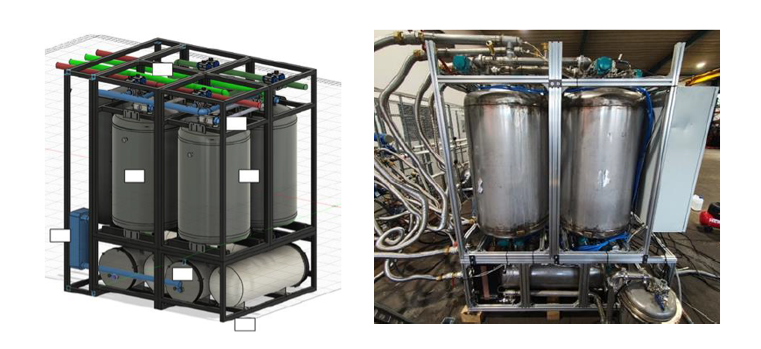
Figure 1: More compact and less expensive: the new generation of a modular adsorption chiller from the German company Sorption Technologies as a design on the left and at the test stand at CNR-ITAE, Italy, on the right. Source: RE-WITCH
The second chiller innovation has been developed by the German universities TU Berlin and Hochschule München in cooperation with the company BS Nova Apparatebau. The two new absorption chillers incorporate two innovative features (see Figure 2). The first combines absorption technology with a mechanical compressor to achieve a greater temperature lift as a hybrid chiller, enabling simultaneous heating and cooling. The unit is currently undergoing testing at the Spanish research institute Tecnalia. Following the testing phase, it will be demonstrated under real operating conditions at the industrial site of the Spanish food producer COVAP, with a cooling capacity of 150 kW and a heating capacity of 250 kW. The second development features two evaporator units, allowing it to provide cooling at two different temperature levels. It will be demonstrated under real operating conditions at the Greek biomass and biofuel producer Miloil, with a cooling capacity of 440 kW.
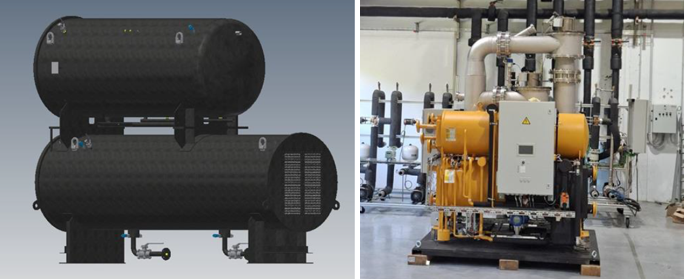
Figure 2: Novel double evaporator absorption chiller and hybrid absorption chiller both from the German company BS Nova Apparatebau, providing cooling at two different temperature levels as well as achieving a high temperature lift, respectively. The unit on the right combines a turbo-compression chiller with an absorption chiller. Source: RE-WITCH
“A special feature of the four RE-WITCH demonstrators is that the project partners IDP will develop digital twins of the complete thermal cooling systems, enabling us to evaluate the performance of the chiller prototypes accurately,” said Jakob.
The project is progressing according to schedule. Planning for the Polish demonstrator has been completed, while planning for the Spanish and Greek demonstrators is nearing completion. Further work is still required for the Italian demonstrator.
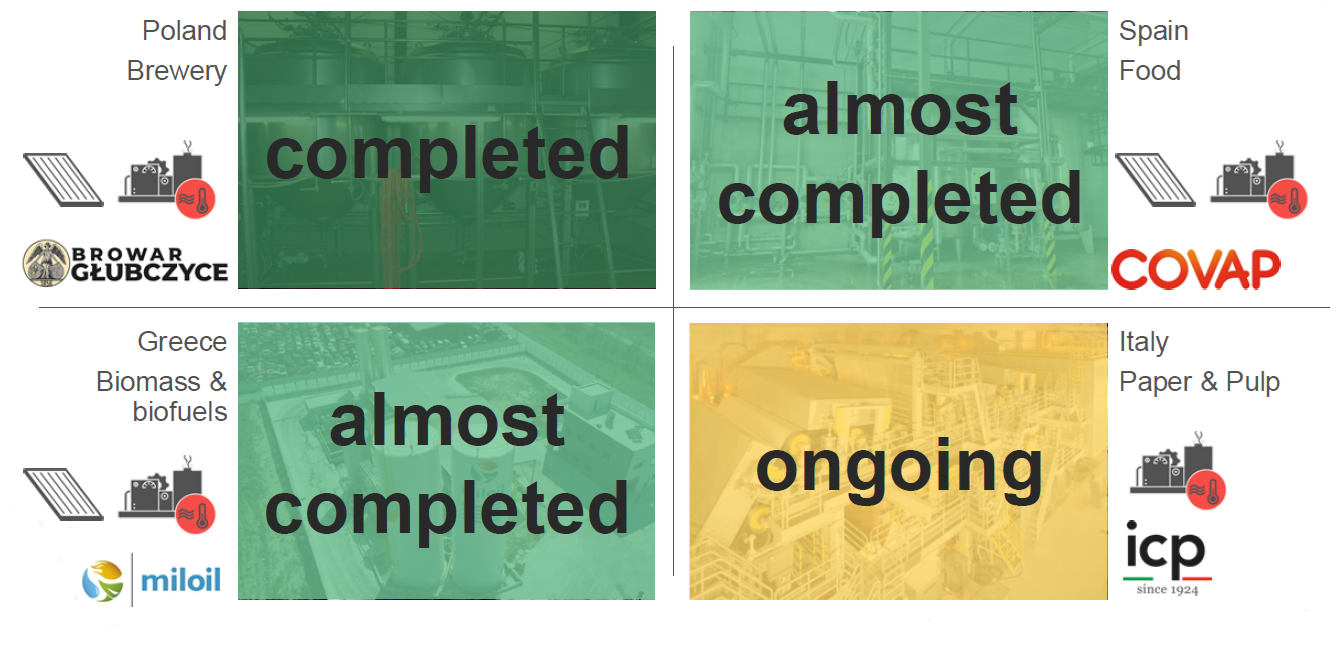
Status quo of the planning of the four demonstrators Source: RE-WITCH
1 Sorption chillers are driven with thermal energy and exist in two versions, as absorption and as adsorption chillers. The difference in only one letter is mainly due to the type of absorbent material. An adsorption chiller uses a solid sorbent such as silica gel or zeolite. The refrigerant (usually water) evaporates at low pressure, extracting heat from the chilled-water circuit, and the vapour is adsorbed by the sorbent. The sorbent is then regenerated by the driving heat, releasing vapour that is condensed and returned to the evaporator. Because the process is cyclic, at least two adsorber beds are operated alternately to provide continuous cooling. An absorption chiller usually works with a liquid absorbent (typically lithium bromide). Heat is supplied to a generator to separate the vapour of the refrigerant (typically water) from the absorbent. The refrigerant vapour is then condensed, expanded, and evaporated at low pressure to produce cooling, while the absorbent captures the refrigerant vapour in an absorber and returns to the generator to repeat the cycle.
Websites of organisations mentioned in this news article:
RE-WITCH: https://ieecp.org/projects/re-witch/
Dr. Jakob energy research GmbH & Co. KG: https://www.drjakobenergyresearch.de/
CNR-ITAE: https://www.itae.cnr.it/en/home/
Sorption Technologies: https://sorption-technologies.com/
BS Nova Apparatebau: https://www.bsnova.de/
Tecnalia: https://www.tecnalia.com/en