Two solar-to-hydrogen approaches to be presented in webinar
October 28, 2026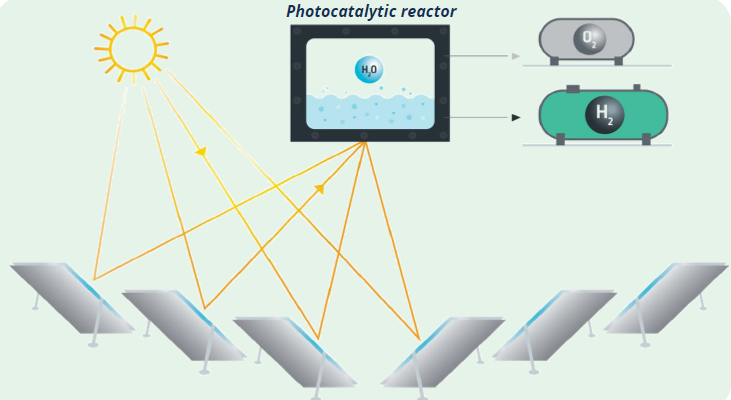
How can solar energy be used not only to generate electricity and heat, but also to produce green hydrogen? Researchers in IEA SHC Task 72, titled Solar Photoreactors for the Production of Fuels and Chemicals, are addressing this challenge. One approach is pursued by Australian company Sparc Hydrogen, established in 2022 to commercialise thermo-photocatalytic water-splitting technology for green hydrogen production (see graphic). The second approach is being developed jointly by Austrian research institute AEE INTEC and Ulm University in Germany. Its core element is the so-called Stirred Loop Photoreactor (SLPR), which produces hydrogen through a photocatalytic reaction. The three-litre prototype is at an early stage of TRL 5–6 and was operated and monitored for a short period in September 2025. Both approaches will be presented in the webinar Solar-to-X: From Sunlight to Molecules, taking place on Tuesday, 10 November, at 3:30 pm GMT or Thursday, 12 November, at 6:30 am GMT. Registration is open online.
Graphic: Sparc Hydrogen
“At Sparc Hydrogen, we use photocatalytic water splitting, a process inspired by natural photosynthesis. In this system, sunlight is absorbed by a semiconductor photocatalyst, creating electron-hole pairs that drive redox reactions to split water into hydrogen and oxygen,” explained Greg Metha, Professor of Chemistry at Adelaide University. Sparc Hydrogen is a spin-off company from Metha’s laboratory at Adelaide University, but also a joint venture with two Australian companies, one of them is Sparc Technologies, a technology commercialisation company, the other is Fortescue, one of the world’s largest iron ore producers.
Unlike conventional methods of producing green hydrogen via electrolysis, which require electricity from renewable energy sources, the photocatalytic reaction utilises sunlight directly, thereby eliminating the need for electrolysers and significantly reducing the complexity of the system. By eliminating the intermediate step of electricity generation, the process reduces energy losses and can be used on a decentralised basis in sunny locations without the need for a grid connection.
The first pilot plant using a photocatalytic reaction was built at the Roseworthy Campus of Adelaide University in 2025 (see Figure 1). It consists of commercially available linear Fresnel mirrors from the Spanish company Solatom. The mirrors concentrate sunlight onto patented reactors where the photocatalytic hydrogen process takes place, thereby increasing the reaction rate. According to Metha, the first hydrogen was produced in December 2025 and the pilot plant has been operational every day since.
The photocatalyst sheets for the pilot plants were delivered by the Japanese Shinshu University. The sheets are based on titanium dioxide particles which is doped with materials that makes the charge separation very efficient. The sheets also have an efficient co-catalyst on them which assist with the production of hydrogen and oxygen on the surface of the particles. “As these photocatalysts are white, they’re not absorbing visible light, but they are only UV active. So, although, they have a very high efficiency in UV usage, overall the solar-to-hydrogen efficiency is still only about 1%,” summarised Metha the results of the pilot plant operation.
The next technology step is already planned. Sparc Hydrogen entered into an agreement with SunHydrogen in August 2026, a US-based company that provides solar reactor modules to be used in photocatalytic reactors that demonstrated a solar-to-hydrogen efficiency of above 10 % in preliminary laboratory testing, according to Metha.
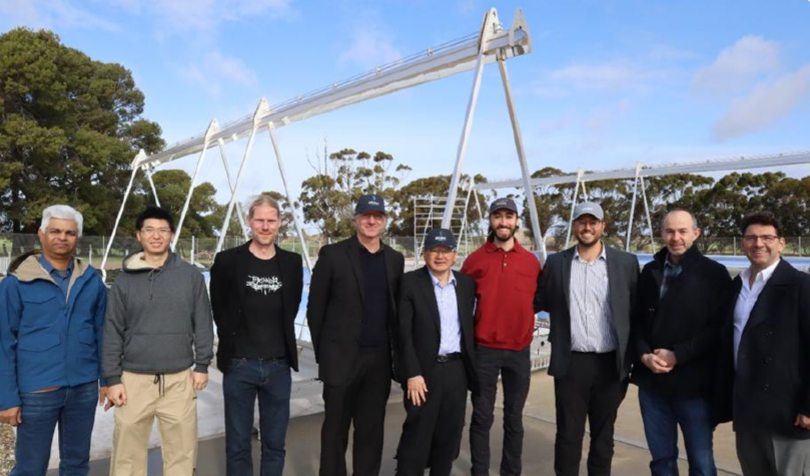
Figure 1: Pilot plant of photocatalytic hydrogen production at Roseworthy Campus at Adelaide University with 168 m2 of linear Fresnel mirrors and locally manufactured, patented reactors Photo: Adelaide University
Low-cost photoreactor falls short under real sunlight conditions
The Stirred Loop Photoreactor (SLPR) offers another approach to hydrogen production driven directly by sunlight. At the heart of the system is a three-litre reactor made of borosilicate glass. It consists of four modular parts that enable gas purging, cooling and stirring (see Figure 2). The photocatalyst comprises carbon nitride particles loaded with molybdenum sulphide clusters. The carbon nitride absorbs the light, while the clusters act as a co-catalyst to support the hydrogen evolution reaction.
“The newly coined term Stirred Loop Photoreactor describes the circulation of the reaction liquid within the reactor,” explained Prof Dirk Ziegenbalg, Professor of Chemical Engineering at Ulm University. “The convection required for this is generated by a stirring shaft fitted inside the reactor, which continuously circulates the reaction medium through the illuminated zone.”
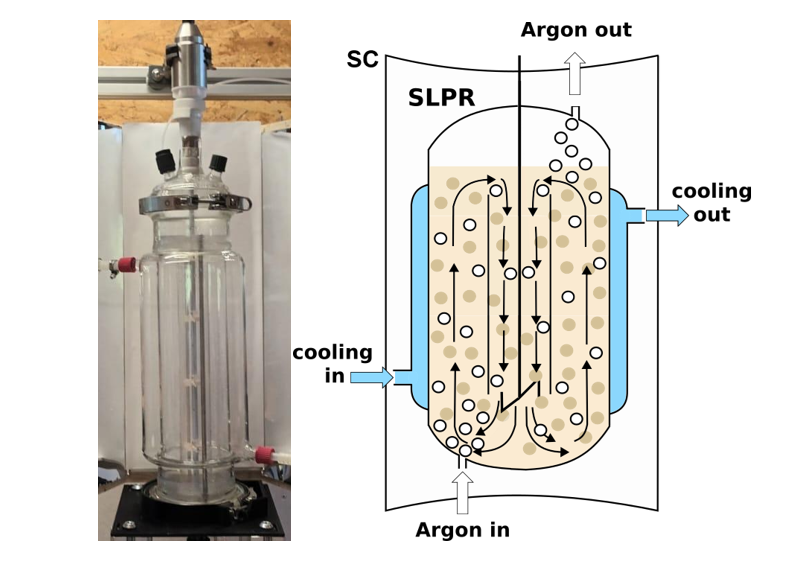
Figure 2: Stirred Loop Photoreactor (SLPR) (left) and schematic of its operating principle (right). Argon is continuously fed into the reactor to remove oxygen and to transport the hydrogen produced, together with the argon carrier gas, to the top of the reactor, where the gas stream is diverted for subsequent analysis. Source: [1]
Initial measurements with the SLPR were carried out in the laboratory using artificial UV light sources. The next challenge was to operate the reactor under natural sunlight. To increase the light intensity reaching the SLPR, the researchers designed a combined specular and diffuse solar collector consisting of mirrors from PTFE diffuser sheet (see Figure 3). Using ray-tracing simulations, they optimised the mirrors for wavelengths below 400 nanometres, which the catalyst can absorb. The mirror-and-diffuser combination redirects both direct and scattered sunlight towards the reactor. This increases the usable UV power reaching it by a factor of 2.4 compared with the reactor operating without the collector.
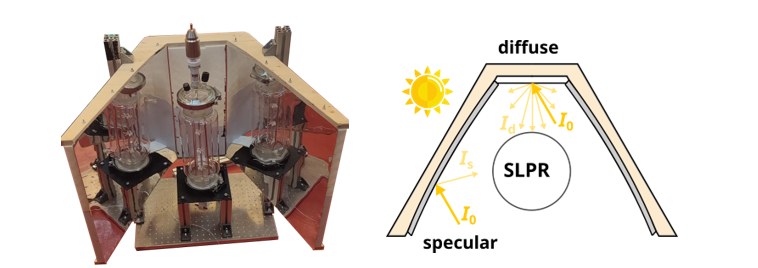
Figure 3: Reactor equipped with PTFE diffuser sheets (left) and schematic of the reflector’s operating principle (right). Source: [1]
To validate the system, the team installed the reactor and collector on the roof of AEE INTEC’s solar testing facility in Gleisdorf, Austria. Two full-day trials were conducted in September 2025, with operation starting around midday to capture peak solar intensity.
The results showed that hydrogen production closely followed the sun’s intensity, increasing through the morning, peaking around solar noon and declining sharply afterwards on both trial days. Overall catalytic activity, however, was markedly lower than under artificial lighting provided by constant 365-nanometre LEDs. The researchers attributed this difference primarily to the much lower and more variable photon flux under natural sunlight, rather than to any fundamental shortcomings in the catalyst or reactor design.
The solar-to-hydrogen conversion efficiency itself remained low, on the order of 2.78 ∙ 10 4 % largely because the carbon nitride catalyst absorbs almost exclusively in the ultraviolet and leaves the much larger visible-light portion of the solar spectrum untapped. Nevertheless, the researchers concluded that the demonstration establishes the feasibility of the concept using a potentially durable, low-cost catalyst system.
Websites of organisations mentioned in this news article:
University of Adelaide: https://adelaide.edu.au/
Sparc Hydrogen: https://www.sparchydrogen.com/
Solatom: https://solatom.com/
Shinshu University: https://www.shinshu-u.ac.jp/english/
SunHydrogen: https://www.sunhydrogen.com/
AEE INTEC: https://www.aee-intec.at/en/
University Ulm: https://www.uni-ulm.de/
[1] Preprint: Daniel Kowalczyka, Johannes Liessemb, Mohamed M. Elnagarb, Moritz Jahnc, Josephin Paetzoldd, Sarah Meitzd, Daniel Rüdisserd, Bettina Muster-Slawitsch, Radim Beranek, Carsten Streb, Dirk Ziegenbalg: “Demonstrating solar hydrogen evolution using thiomolybdate-modified carbon nitrides in a mass transport intensified 3 L loop photoreactor – A feasibility study”