Main takeaways from IEA SHC Task 71: Towards unified metrics of LCA and LCoH for heating technologies
April 27, 2026
Karl-Anders Weiß has spent the past three years intensively working on the life cycle and cost assessment of alternative heating technologies. The researcher from the German institute Fraunhofer ISE has led Task 71 of the IEA Solar Heating and Cooling Programme on this very topic, which has now concluded after three years. The most important milestone: the researchers developed a harmonized method for calculating both the environmental impact (life cycle assessment = LCA) and the levelized cost of heat (LCoH) for heating systems. This method was applied to various heating technologies, including gas boilers, heat pumps, PVT combined with heat pumps and biomass combined with solar thermal systems. In this article, Weiß outlines and explains the key takeaways from Task 71 and announces several upcoming publications, which will be released gradually on the Task 71 website in the publications section.
Photo: Fraunhofer ISE
1. The regulations aimed at reducing greenhouse gas emissions and/or fossil fuel consumption in heating systems vary widely from country to country and need to be harmonized.
Task 71 provides an overview of regulations for energy-efficient buildings and residential heating systems across ten countries, as presented in the report “Regulations for Heating Systems – National Situation and International Overview”, which is already available for download (link). Denmark, for example, has set a cap of 30 kWh/m² per year for energy used in heating, ventilation, cooling, and domestic hot water combined. France applies a primary energy consumption coefficient to define the maximum allowable total energy use of a building. In Germany, new heating systems had to include at least a 65% share of renewable energy (a regulation which was changed by the new government in May 2026). In an upcoming position paper, the Task 71 researchers call for greater harmonization of regulatory frameworks – at least across Europe – to make it easier for heating equipment manufacturers to meet requirements in different markets and, as a result, reduce costs for consumers. In the position paper it says:
As an international expertise-based institution with the goal of supporting ecologically and economically sustainable heat supply, we strongly recommend harmonizing regulations and reporting formats for the heating sector to support and accelerate the transformation of the heat supply for domestic buildings. We see internationally agreed formats to supply data describing heating systems as well as heat demand of buildings as an essential and easy to realize step to reduce the overall effort related to the fulfilment of regulations.
2. The ecological and economic assessment of heating systems must be integrated into a single evaluation framework.
This principle lies at the core of Task 71. The outcome is a comprehensive 50-page set of guidelines (to be published soon) that detail methodologies for both life cycle assessment and the levelized cost of heat (LCoH). Both these approaches are based on a shared, generic description of heating systems and standardized load profiles for various use cases. The guidelines also define system boundaries and recommend structuring systems into subsystems and components. For LCoH, they also provide detailed equations for calculating costs across different system types and configurations.
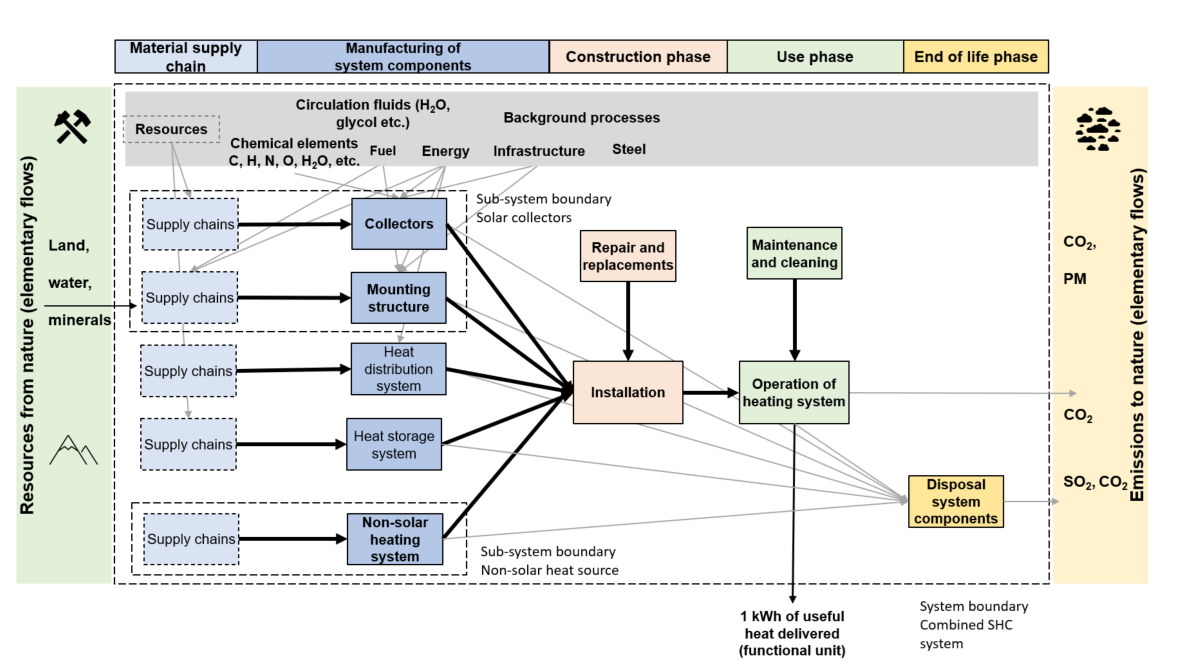
Generic system model for a heating system that consists of a solar thermal system together with a non-solar heating system as support. The environmental impact is assessed across the entire lifetime of the product including the material supply, manufacturing, construction phase, use phase and end-of-life phase. Scheme: ZHAW University, Switzerland
3. The methodology enables a consistent comparison of the environmental impact across a wide range of heating systems.
Task 71 researchers did not limit their work to solar thermal systems; they also analysed technologies such as gas boilers, heat pump systems and hybrid solutions including biomass combined with solar thermal or PVT combined with heat pumps. A key objective was to collaborate with experts from other IEA Technology Collaboration Programmes (TCPs) focusing on these technologies. In particular, Weiß and his international colleagues reached out to the Photovoltaic Power Systems Programme (PVPS), Heat Pumping Technologies (HPT), and District Heating and Cooling (DHC) TCPs. While all three recognized the value and relevance of the approach, their level of involvement varied: the DHC TCP closely supported the drafting of the methodology guidelines, experts from PVPS exchanged directly with the authors of the guidelines and the HPT TCP was consulted internally via Fraunhofer ISE Freiburg.
4. Based on the harmonized methodology for calculating environmental impacts and the levelized cost of heat (LCoH), heating system manufacturers are now expected to provide reliable product data.
Within Task 71, researchers developed typical load profiles for ten different demand cases (see table). These load profiles – provided partly as Excel files and partly as text documents – are gradually being published on the Task 71 website as Info Sheets. Weiß emphasized that, going forward, heating system manufacturers will need to supply detailed product data so that investors and public authorities can compare the environmental performance of different heating systems accurately.
| # | Country | Demand case | Load |
| 1 | Austria | District heating | heating: 7700 MWh/year |
| 2 | Denmark | Low energy single-family house | heating: 7.1 MWh/year |
| 3 | China | Public building, Tibet | heating: 5.2 MWh/year |
| 4 | Germany | New single-family house | heating: 9.6 MWh/year |
| 5 | Germany | Existing single-family house | heating: 23.5 MWh/year |
| 6 | Portugal | Domestic hot water demand SFH | heating:1.8 MWH/year |
| 7 | Spain | Reference load profile of a commercial centre | cooling: 6412 MWh/year |
| 8 | Spain | Reference load profile of a 12-dwelling building | heating: 70 MWh/year, cooling: 14 MWh/year |
| 9 | Spain | Reference load profile of a 50-dwelling building | heating: 292 MWh/year, cooling: 58 MWh/year |
| 10 | Switzerland | New single-family house | heating: 24.3 MWh/year |
Standardized load profiles developed within Task 71 and to be published as individual info sheets on the Task 71 publication page. Source: Task 71
5. Discount rate and inflation have a significant impact on the results for LCA and LCoH
Task 71 researchers are currently developing fact sheets that present economic and environmental performance results for selected, generically defined heating systems and load profiles. These fact sheets are designed to be easily understood by investors. The key parameters underlying the calculations are clearly summarized in an Assumptions box, allowing readers to grasp the main inputs at a glance.
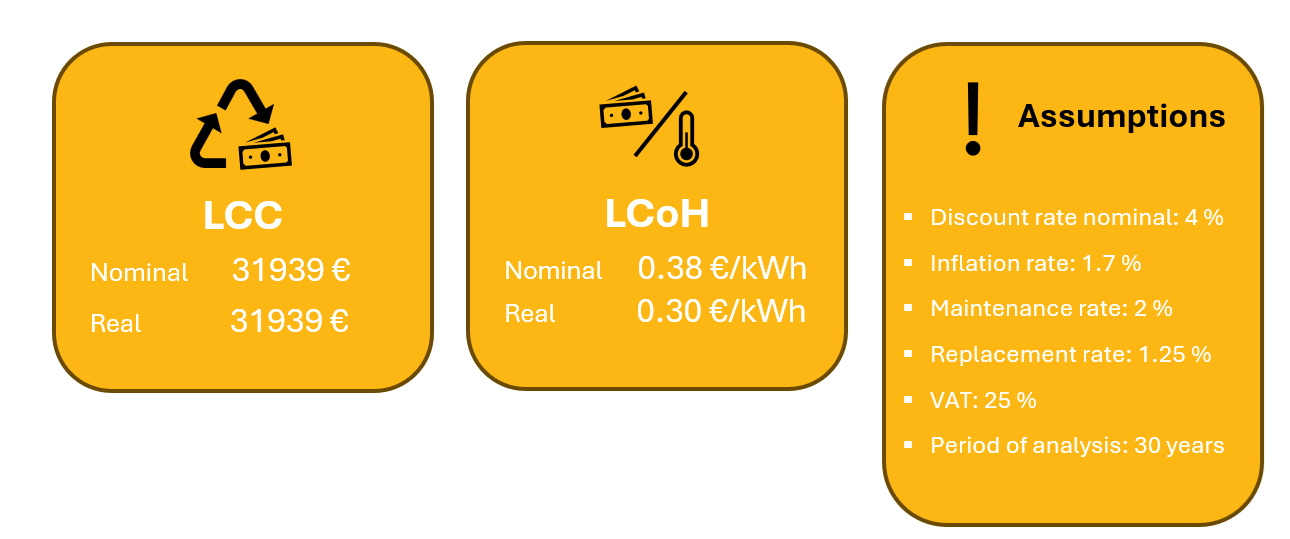
The figure shows the results of the environmental impact assessment for a PVT and heat pump system applied to a low-energy single-family house in Denmark. LCC stands for life cycle cost and LCoH for levelized cost of heat Source: Task 71.
6. Graphical representation of emission contributions has a central role in the fact sheets
The results of LCA include more than ten indicators, as listed in Table 9 of the methodology guidelines. These include metrics such as human toxicity, ozone depletion, land and water use, as well as the resource use of minerals and metals. However, the key indicator is CO₂-equivalent emissions called Global Warming Potential (GWP), which is given a central role in the fact sheets.
Bar charts illustrate how different contributions – such as raw materials and manufacturing of the heating system components – affect the Global Warming Potential (GWP100) indicator (see figures below). The first bar is for a 4.9 kW air-source heat pump in Germany. The production-based emissions are related to the phases of the life of the product (total: 0.086 CO2-eq/kWhth). The production phase has a small impact compared to the use phase, in which fossil-fuel-based electricity is used to run the heat pump.
The second bar represents the carbon footprint for a 12.1 kW air-source heat pump in Portugal. Here, the emission contribution throughout the lifetime is related to the components of the system (total 0.122 kg CO2-eq/kWhth). In this diagram, the exterior wall unit has the largest carbon footprint because it consumes most of the electricity over the year.
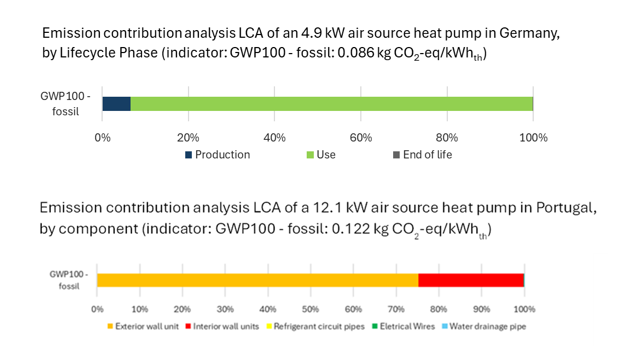
The figure presents results from two fact sheets describing the environmental impact of heat pump systems in Germany and Portugal. The German system shows a lower GWP100 (fossil) indicator. This is due to the fact that the German system delivers a much higher annual thermal energy output (9,563 kWh for heating and hot water) compared to the Portuguese system (1,237kWh for heating and cooling), which means that the relative share of production-phase impacts allocated to each kWh of thermal energy are higher in the Portuguese system. Additional differences may be explained by the difference in the system scale and the applied electricity mix in the use phase. Source: Task 71.
In sum, Task 71 delivers a practical foundation for making heating technologies comparable from both an environmental and an economic perspective. The real impact now depends on consistent data from manufacturers and broader alignment of regulations across markets. If that happens, the methodology can move from theory into everyday decision-making – giving investors, planners and engineers a clear, common basis for choosing more efficient and sustainable heating solutions.
Websites of organizations mentioned in this news article:
IEA Solar Heating and Cooling Programme: https://www.iea-shc.org/
IEA SHC Task 71: https://task71.iea-shc.org/
IEA Photovoltaic Power Systems Programme (PVPS): https://iea-pvps.org/
IEA Heat Pumping Technologies (HPT): https://heatpumpingtechnologies.org/
IEA District Heating and Cooling (DHC): https://www.iea-dhc.org/home
ZHAW: https://www.zhaw.ch/en/university