Czech Republic: Emission Trading Revenues extend Incentive Programme
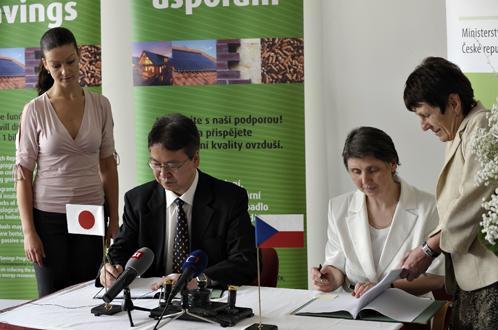
 Signed in July by Rut Bizkova, the Czech Republic's Environment Minister, and Yasuhiro Shimizu, Japanese Executive Director of the New Energy and Industrial Technology Development Organization, the new supplement to an emission trading contract leads to improvements in the Green Savings Programme.
Photo: Zelena Usporam
The recently signed supplement stipulates the sale of a large, yet undisclosed, quantity of Assigned Amount Units (AAUs) to the Japanese side and requires Czech authorities to spend the gained capital for CO2 saving measures. The new agreement is therefore a great improvement with respect to the Green Savings programme, which receives all of its funds out of emission trading revenues. Besides solar thermal systems, the scheme subsidizes insulation measures, the implementation of passive energy standards in construction projects, low-emission burners with biomass as their energy source and efficiency-improved heat pumps.
Between March 2009, when the programme was launched, and May 2010, the Czech Republic earned approximately Czech Koruny (CZK) 20 billion (EUR 864 million) through the sale of AAU units. Until June 2010, authorities received 33,000 applications for solar thermal systems requesting funds of, in total, CZK 9 billion (EUR 353 million). So far, more than 23,000 applications have been approved, which translates into a granted subsidy amount of CZK 5 billion. Only about 7% of these granted subsidies, however, have already been made available to the applicants by now, because the entire subsidy is paid out only if the respective project has been completed.
There are approximately 25,000 AAU left to sell. The revenue expected until 2012 is 25 billion CZK (EUR 981 million); because the price of an AAU is not fixed, it may be more or less than the original estimate. Nevertheless, such a generous budget will allow the government to extend the subsidy programme it actually intended to halt several times during the first half of 2010. Residential solar water systems are still rebated with CZK 55,000 (EUR 2,160) and combi systems, which supply energy for hot water generation and space heating, are subsidized with CZK 80,000 (EUR 3,140) (further details in the table below).
The most important change in the new regulations from July 2010 concerns the public sector: Cities, towns, villages, state-owned companies and churches are now all able to receive subsidies from the programme in order to implement energy-saving measures. “We see this step as a significant help to the country's municipalities. And this at a time when those municipalities don't have enough money because of the critical drop in tax revenue after the economic crisis," Bizkova, the Czech Minister of Environment, said. The total budget for public buildings is limited to CZK 6 billion. Since 90 % of the energy-saving measures (which includes solar thermal systems) have their maximum incentive set at CZK 200 million per application (EUR 7.8 million), it is most likely the available budget will be exceeded in a short period of time. Due to the large budget reserved in favour of the public sector, the industry fears that the residential programme will also run out of money before 31 December 2012.
More information:
http://www.zelenausporam.cz
The text was written by Vladislava Adamenkova, a Czech student of international business studies in Vienna.
|
Country / region |
Czech Republic |
|
Name of programme |
Zelena Usporam (Green Savings) |
|
Type of incentive |
Subsidy |
|
Eligible technologies |
Solar thermal systems, biomass boilers and heat pumps, insolation |
|
Applicable sectors |
Primarily residential home owners, who might also have rented their house to somebody. For a short period between 19 June and 31 August 2010 public institutions like cities, towns, villages and regions can apply for a subsidy |
|
Amount |
Residential hot water systems: Czech Korun (CZK) 55,000 |
|
Maximum incentive |
Fixed subsidies for residential systems: CZK 55,000 and 80,000 for solar thermal systems There is an additional bonus if a home owner combined the installation of a solar system with another environmentally friendly way of heating water or the household itself. Applications from the public sector up to a max. of CZK 200 million. |
|
Requirements for system |
The solar system must come from a supplier, which registered with the programme (you will find a list of registered suppliers under the following link) Systems are approved for the subsidy if they reach 350 kWh/m2 for hot water systems or 280KWh/m2 for combi systems |
|
Requirements for installation |
|
|
Finance provider |
Ministry of the Environment
|
|
Total funds |
CZK 20 billion from emission trading spent between March 2009 and May 2010. CZK 25 billion ( approx. EUR 1 billion) for all three technologies: solar thermal systems, biomass boilers and heat pumps for the period between June 2010 and December 2012 |
|
Funding source |
Emission trading under the Kyoto Protocol |
|
Effective date |
March 2009, new requirements since 19th of June 2010 |
|
Expiration date |
The programme stopped in October 2010 and the date of the relaunch is unclear |
|
Website |
http://www.zelenausporam.cz/ http://www.opzp.cz http://www.sfzp.cz/ |
|
Last review of this tabloid |
July 2011 |
|
Contact |
Ministry of the Environment |